
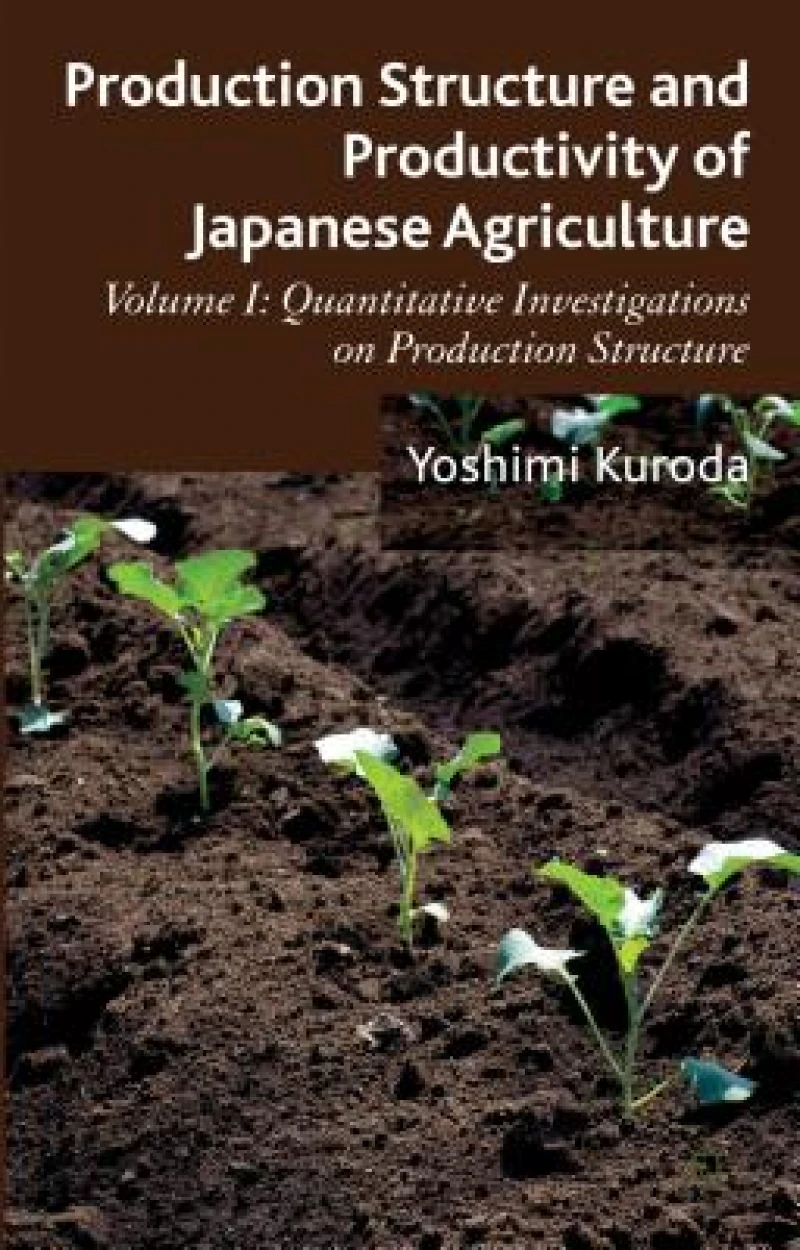
Production Structure and Productivity of Japanese Agriculture : Volume 1: Quantitative Investigations on Production Structure
by
Y. Kuroda
Book Details
Format
Hardback or Cased Book
ISBN-10
1137287608
ISBN-13
9781137287601
Publisher
Palgrave Macmillan
Imprint
Palgrave Macmillan
Country of Manufacture
GB
Country of Publication
GB
Publication Date
Jun 24th, 2013
Print length
357 Pages
Ksh 16,200.00
Werezi Extended Catalogue
0 in stock
Delivery Location
Delivery fee: Select location
Secure
Quality
Fast
Analyses quantitatively in a comprehensive, consistent, and integrated manner the production structure and productivity of post-war Japanese agriculture for the latter half of the twentieth century, more specifically, 1957-97.
By departing from conventionally analytical tools such as Cobb-Douglas and CES production functions, the author quantitatively analyses the production structure and productivity of Japanese agriculture for the second half of the 20th century. To achieve this objective the book uses newly developed analytical tools from the early-1950s through to the 1980s such as the duality theorem, flexible functional forms, and index number theories. By making full use of these newly developed analytical tools, the author offers comprehensive, consistent, integrated, and reliable empirical results for analysing the production structure and productivity of postwar Japanese agriculture.
Volume 1 utilises the crop-livestock multiple product total and variable translog cost to quantitatively assess production structure and productivity from 1957-1997. Important indicators of production are estimated for different size classes for each
year and are compared over time. Furthermore, a distinctive feature of Volume 1 is the introduction of a newly devised method for decomposing the growth rate of labor productivity. This process departs from the conventional Solow growth account method, which is not explicitly integrated with the theory of the firm.
Volume 1 utilises the crop-livestock multiple product total and variable translog cost to quantitatively assess production structure and productivity from 1957-1997. Important indicators of production are estimated for different size classes for each
year and are compared over time. Furthermore, a distinctive feature of Volume 1 is the introduction of a newly devised method for decomposing the growth rate of labor productivity. This process departs from the conventional Solow growth account method, which is not explicitly integrated with the theory of the firm.
Get Production Structure and Productivity of Japanese Agriculture by at the best price and quality guaranteed only at Werezi Africa's largest book ecommerce store. The book was published by Palgrave Macmillan and it has pages.

