Proust, Class, and Nation
Book Details
Format
Hardback
ISBN-10
0199609861
ISBN-13
9780199609864
Publisher
Oxford University Press
Imprint
Oxford University Press
Country of Manufacture
GB
Country of Publication
GB
Publication Date
Sep 8th, 2011
Print length
316 Pages
Weight
520 grams
Dimensions
21.90 x 14.60 x 2.30 cms
KSh 25,300.00
Currently unavailable
0 in stock
Delivery Location
Delivery fee: Select location
Secure
Quality
Fast
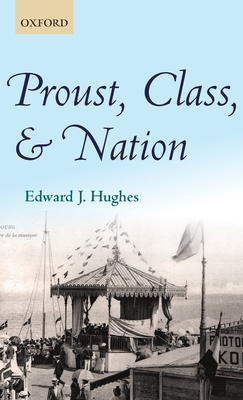
How might Proust's work be understood in relation to issues of class and nation? A la recherche du temps perdu was produced in momentous times - the Dreyfus Affair and the Separation of Church and State; the First World War and the consequent Germanophobia; and the continuing polarization in class politics - which all find echoes in the novel.
Writing in 1927, Julien Benda described France as being afflicted by the twin scourges of narrow, class-based politics and rabid nationalism. He nevertheless identified Marcel Proust (who had died in 1922) as a writer who had refused to embrace the ideological narrowness of his age. Edward J. Hughes seeks to assess how Proust and his novel A la recherche du temps perdu might be understood in relation to issues of class and nation. A la recherche was produced in momentous times. As an extended textual construction, first conceived of in 1908 and the last tranche of which appeared posthumously almost two decades later, it was assembled against a backdrop of major historical events: pre-war tensions in the wake of the Dreyfus Affair and the Separation of Church and State (issues on which Proust had campaigned publicly); the First World War and the atmosphere of narrow nationalism and Germanophobia which the conflict generated; and the continuing polarization in class politics in the years after the First World War. These all find echoes in A la recherche and Hughes establishes how the exposure given to questions of class and nation needs to be understood historically. He demonstrates that the frequently entrenched positions of Proust''s contemporaries at times square with the language and images of social conservativism to be found in A la recherche. Yet alongside that, Hughes unearths evidence that points to Proust as a free-floating, often playful, iconoclast and radical commentator who, as Theodor Adorno observed, resisted bourgeois compartmentalization.
Get Proust, Class, and Nation by Edward J. Hughes at the best price and quality guaranteed only at Werezi Africa's largest book ecommerce store. The book was published by Oxford University Press and it has 316 pages.
Customers Who Bought This Also Bought

Dreams in a Time of War
KSh 3,050.00
Modern Classics Penguin Essays of George Orwell
KSh 2,700.00

On Writing
KSh 2,000.00

To the Lighthouse
KSh 1,450.00

On Morrison
KSh 4,500.00

Africa''s Tarnished Name
KSh 700.00
C. S. Lewis
KSh 1,800.00

Life in Letters
KSh 5,400.00

By Grand Central Station I
KSh 1,800.00
Wide Sargasso Sea
KSh 1,800.00

Mom and Me and Mom
KSh 2,000.00
Jorge Luis Borges
KSh 1,800.00