
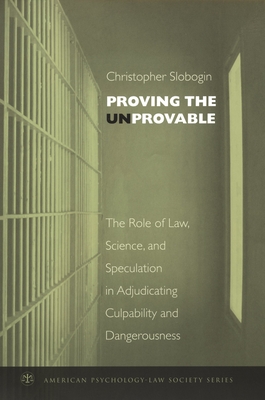
Proving the Unprovable : The Role of Law, Science, and Speculation in Adjudicating Culpability and Dangerousness
Book Details
Format
Hardback
Book Series
American Psychology-Law Society Series
ISBN-10
0195189957
ISBN-13
9780195189957
Publisher
Oxford University Press Inc
Imprint
Oxford University Press Inc
Country of Manufacture
US
Country of Publication
GB
Publication Date
Sep 28th, 2006
Print length
208 Pages
Weight
502 grams
Dimensions
23.70 x 16.50 x 2.10 cms
Product Classification:
Criminal law & procedureCriminal law: procedure and offences
KSh 15,500.00
Currently unavailable
0 in stock
Delivery Location
Delivery fee: Select location
Secure
Quality
Fast
It is hard enough in many cases simply figuring out whether a person has committed an antisocial act. It is harder still to determine the extent to which he or she intended the act, and why he or she committed it. And most difficult of all is divining whether a person will harm again. The law has increasingly turned to mental health professionals to help address these issues, particularly the last two. Because of their familiarity with and study of human behavior, psychiatrists, psychologists and other clinicians are thought to possess special expertise in assessing culpability and dangerousness. Members of these groups routinely furnish the courts with evaluations of insanity and other mental state at the time of the offense, and even more frequently proffer predictions about future behavior. Both culpability and dangerousness are exceedingly difficult to gauge; even mental health professionals well-versed in the behavioral sciences cannot claim a high degree of reliability in their efforts to address these issues. Though the current trend in evidence law is to demand a rigorous demonstration of scientific validity from expert witnesses, especially when those experts are mental health professionals proffered by the defense, this book argues that this is a mistake. Such a position undermines the fairness of the process and could quite possibly even diminish its reliability, given the defense''s constitutional entitlement to tell its story and the inscrutability of past and future mental states. At the same time, Professor Slobogin proposes a number of ways the courts can ensure that experts provide the best possible information about ultimately unknowable past mental states and future behavior.
Get Proving the Unprovable by Christopher Slobogin at the best price and quality guaranteed only at Werezi Africa's largest book ecommerce store. The book was published by Oxford University Press Inc and it has 208 pages.
Customers Who Bought This Also Bought

Yahoo Boys
KSh 3,950.00
Framed
KSh 2,000.00

Jeremy Hutchinson''s Case Histories
KSh 2,500.00

The Cambridge Handbook of Compliance
KSh 9,550.00
Confessions in the Courtroom
KSh 16,750.00
Confessions in the Courtroom
KSh 26,450.00

Cognitive Psychology for Forensic Experts
KSh 10,250.00

306-323
KSh 42,400.00
Procedural Justice?
KSh 13,150.00
The Spectacle
KSh 13,500.00
The Political Heart of Criminal Procedure
KSh 6,100.00
Scottish Criminal Law Essentials
KSh 16,200.00
More by Christopher Slobogin

Psychological Evaluations for the Courts, Fifth Edition
KSh 21,050.00
Psychological Evaluations for the Courts
KSh 21,650.00
Minding Justice
KSh 12,750.00
Just Algorithms
KSh 18,700.00

Rehabilitating Criminal Justice
KSh 5,900.00
Just Algorithms
KSh 6,100.00
Virtual Searches
KSh 5,250.00

Virtual Searches
KSh 3,600.00

Rehabilitating Criminal Justice
KSh 17,100.00
