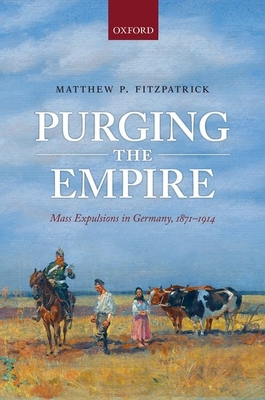
Purging the Empire : Mass Expulsions in Germany, 1871-1914
Book Details
Format
Hardback
ISBN-10
0198725787
ISBN-13
9780198725787
Publisher
Oxford University Press
Imprint
Oxford University Press
Country of Manufacture
GB
Country of Publication
GB
Publication Date
Jan 8th, 2015
Print length
320 Pages
Weight
630 grams
Dimensions
24.20 x 16.20 x 2.30 cms
KSh 22,300.00
Temporarily out of stock, due soon
0 in stock
Delivery Location
Delivery fee: Select location
Secure
Quality
Fast
Addresses the mass expulsion of Germany's unwanted residents, including Socialists, Jesuits, Danes, colonial subjects, French nationalists, Poles, and 'Gypsies', between 1871 and 1914.
While the fate of minorities under Nazism is well known, the earlier expulsions of Germany''s unwanted residents are less well understood. Against a backdrop of raging public debate, and numerous claims of a ''state of exception'', tens of thousands of vulnerable people living in the German Empire were the victims of mass expulsion orders between 1871 and 1914. Groups as diverse as Socialists, Jesuits, Danes, colonial subjects, French nationalists, Poles, and ''Gypsies'' were all removed, under circumstances that varied from police actions undertaken by provincial governors through to laws authorising removals passed by the Reichstag.Purging the Empire examines the competing voices demanding the removal or the preservation of suspect communities, suggesting that these expulsions were enabled by the decentralised and participatory nature of German politics. In a surprisingly responsive political system, a range of players, including the Kaiser, the Reichstag, the bureaucracy, provincial officials, and local police authorities were all empowered to authorise the expulsion of unwanted residents. Added to this, the German press, civic associations, chambers of commerce, public intellectuals, religious societies, and the grassroots membership of political parties all played an important role in advocating or denouncing the measures before, during and after their implementation. Far from revealing the centrality of authoritarian caprice, Germany''s mass expulsions point to the diffuse nature of coercive sovereign power and the role of public pressure in authorising or censuring the removals that took place in a modern, increasingly parliamentary Rechtsstaat.
Get Purging the Empire by Matthew P. Fitzpatrick at the best price and quality guaranteed only at Werezi Africa's largest book ecommerce store. The book was published by Oxford University Press and it has 320 pages.
Customers Who Bought This Also Bought

Age of Revolutions
KSh 2,350.00

Eichmann in Jerusalem
KSh 2,350.00

Trouble With Being Born
KSh 2,000.00

Hiroshima
KSh 2,000.00

Freedom
KSh 6,300.00

Holocaust
KSh 2,700.00
The History of the Peloponnesian War
KSh 2,700.00
Annals
KSh 2,350.00
Greek Lives
KSh 2,150.00

Sleepwalkers
KSh 3,400.00

Napoleon The Great
KSh 3,600.00

Diary of a Young Girl
KSh 1,800.00