
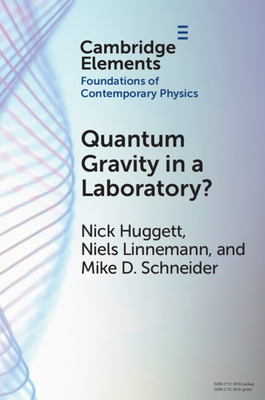
Quantum Gravity in a Laboratory?
Book Details
Format
Paperback / softback
ISBN-10
1009327534
ISBN-13
9781009327534
Publisher
Cambridge University Press
Imprint
Cambridge University Press
Country of Manufacture
GB
Country of Publication
GB
Publication Date
Aug 3rd, 2023
Print length
98 Pages
Weight
164 grams
Dimensions
15.20 x 22.90 x 0.90 cms
Product Classification:
History of science
KSh 3,250.00
Currently unavailable
0 in stock
Delivery Location
Delivery fee: Select location
Secure
Quality
Fast
This Element critically investigates proposed tabletop experiments controversially claimed to produce and 'witness' the first laboratory quantum gravity phenomena.
The characteristic – Planck – energy scale of quantum gravity makes experimental access to the relevant physics apparently impossible. Nevertheless, low energy experiments linking gravity and the quantum have been undertaken: the Page and Geilker quantum Cavendish experiment, and the Colella-Overhauser-Werner neutron interferometry experiment, for instance. However, neither probes states in which gravity remains in a coherent quantum superposition, unlike – it is claimed – recent proposals. In essence, if two initially unentangled subsystems interacting solely via gravity become entangled, then theorems of quantum mechanics show that gravity cannot be a classical subsystem. There are formidable challenges to such an experiment, but remarkably, tabletop technology into the gravity of very small bodies has advanced to the point that such an experiment might be feasible in the near future. This Element explains the proposal and what it aims to show, highlighting the important ways in which its interpretation is theory-laden.
Get Quantum Gravity in a Laboratory? by Mike D. Schneider, Nick Huggett at the best price and quality guaranteed only at Werezi Africa's largest book ecommerce store. The book was published by Cambridge University Press and it has 98 pages.
Customers Who Bought This Also Bought

Anaximander
KSh 2,000.00

When Breath Becomes Air
KSh 1,800.00

On the Origin of Species
KSh 1,600.00

Origin of Species
KSh 1,850.00
There Are Places in the World Where Rules Are Less Important Than Kindness
KSh 2,350.00

Every Living Thing
KSh 2,350.00

Everything Is Tuberculosis
KSh 3,950.00
Short History of Nearly Everything 2.0
KSh 3,550.00

Short History of Nearly Everything
KSh 2,350.00

Classics Origin of Species
KSh 1,100.00

Essential Galileo
KSh 2,900.00
Helgoland
KSh 2,350.00


