
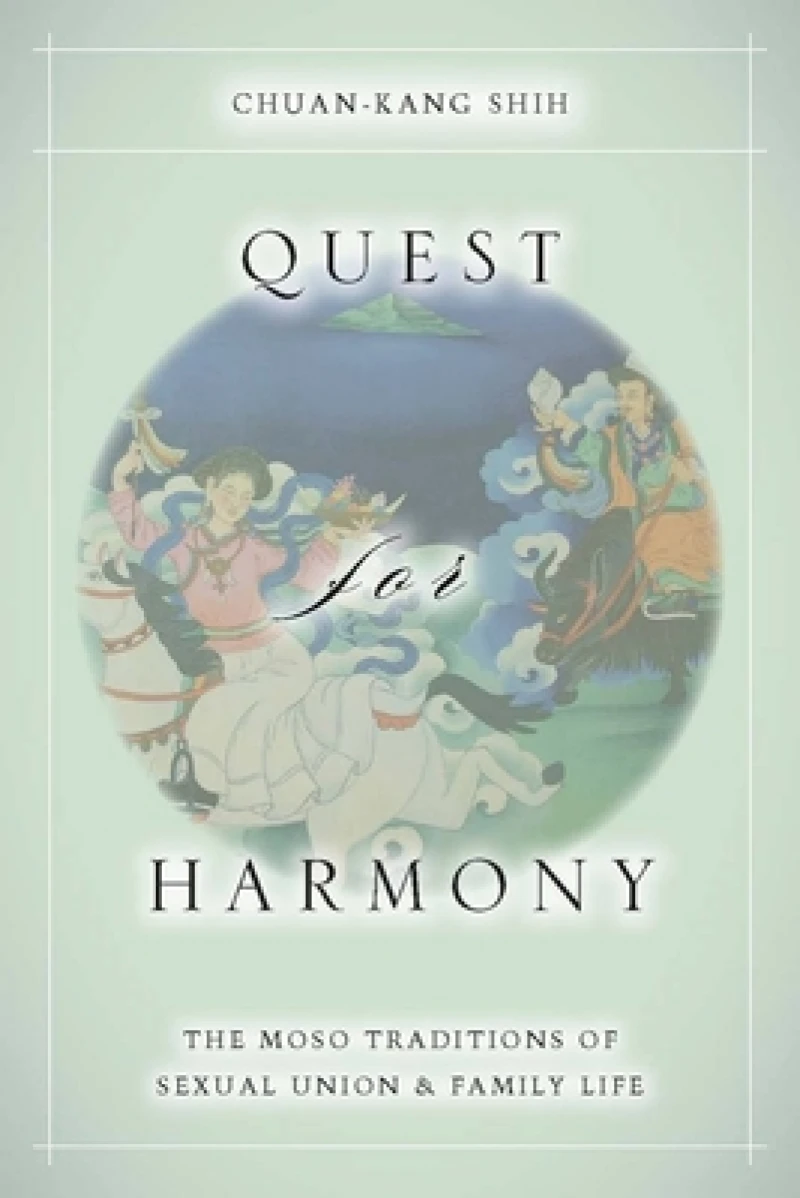
Quest for Harmony – The Moso Traditions of Sexual Union and Family Life. : The Moso Traditions of Sexual Union and Family Life.
New
Book Details
Format
Hardback or Cased Book
ISBN-10
080476199X
ISBN-13
9780804761994
Edition
New
Publisher
Stanford University Press
Imprint
Stanford University Press
Country of Manufacture
US
Country of Publication
GB
Publication Date
Dec 7th, 2009
Print length
352 Pages
Weight
692 grams
Dimensions
16.20 x 23.60 x 3.10 cms
Product Classification:
Asian historyAnthropologyPhysical anthropologyAsian history
Ksh 12,250.00
Werezi Extended Catalogue
0 in stock
Delivery Location
Delivery fee: Select location
Secure
Quality
Fast
This is a comprehensive ethnographic study about the Moso, a matrilineal group in Southwest China, whose unique traditions are bound to change accepted notions of marriage, kinship, the family, and gender relations.
In this long-awaited ethnography, Chuan-kang Shih details the traditional social and cultural conditions of the Moso, a matrilineal group living on the border of Yunnan and Sichuan Provinces in southwest China. Among the Moso, a majority of the adult population practice a visiting system called tisese instead of marriage as the normal sexual and reproductive institution. Until recently, tisese was noncontractual, nonobligatory, and nonexclusive. Partners lived and worked in separate households. The only prerequisite for a tisese relationship was a mutual agreement between the man and the woman to allow sexual access to each other. In a comprehensive account, Quest for Harmony explores this unique practice specifically, and offers thorough documentation, fine-grained analysis, and an engaging discussion of the people, history, and structure of Moso society. Drawing on the author's extensive fieldwork, conducted from 1987 to 2006, this is the first ethnography of the Moso written in English.
Get Quest for Harmony – The Moso Traditions of Sexual Union and Family Life. by at the best price and quality guaranteed only at Werezi Africa's largest book ecommerce store. The book was published by Stanford University Press and it has pages.

