
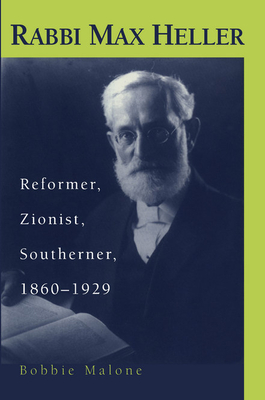
Rabbi Max Heller : Reformer, Zionist, Southerner, 1860-1929
Book Details
Format
Paperback / softback
Book Series
Judaic Studies Series
ISBN-10
0817357661
ISBN-13
9780817357665
Publisher
The University of Alabama Press
Imprint
The University of Alabama Press
Country of Manufacture
US
Country of Publication
GB
Publication Date
Jul 1st, 2013
Print length
296 Pages
Weight
460 grams
Dimensions
23.40 x 15.70 x 2.00 cms
Product Classification:
Biography: religious & spiritualBiography: religious and spiritualJudaismJudaism
KSh 4,500.00
Temporarily out of stock, due soon
0 in stock
Delivery Location
Delivery fee: Select location
Secure
Quality
Fast
This biography of a pioneering Zionist and leader of American Reform Judaism adds significantly to our understanding of American and southern Jewish history. Max Heller's life experience provides a distinct vantage point from which to view the complexity of race relations in New Orleans and the South and the confluence of cultures that molded his development as a leader.
This biography of a pioneering Zionist and leader of American Reform Judaism adds significantly to our understanding of American and southern Jewish history.
Max Heller was a man of both passionate conviction and inner contradiction. He sought to be at the center of current affairs, not as a spokesperson of centrist opinion, but as an agitator or mediator, constantly struggling to find an acceptable path as he confronted the major issues of the day-racism and Jewish emancipation in eastern Europe, nationalism and nativism, immigration and assimilation. Heller''s life experience provides a distinct vantage point from which to view the complexity of race relations in New Orleans and the South and the confluence of cultures that molded his development as a leader. A Bohemian immigrant and one of the first U.S.-trained rabbis, Max Heller served for 40 years as spiritual leader of a Reform Jewish congregation in New Orleans-at that time the largest city in the South. Far more than a congregational rabbi, Heller assumed an activist role in local affairs, Reform Judaism, and the Zionist movement, maintaining positions often unpopular with his neighbors, congregants, and colleagues. His deep concern for social justice led him to question two basic assumptions that characterized his larger social milieu-segregation and Jewish assimilation.
Heller, a consummate Progressive with clear vision and ideas substantially ahead of their time, led his congregation, his community, Reform Jewish colleagues, and Zionist sympathizers in a difficult era.
Max Heller was a man of both passionate conviction and inner contradiction. He sought to be at the center of current affairs, not as a spokesperson of centrist opinion, but as an agitator or mediator, constantly struggling to find an acceptable path as he confronted the major issues of the day-racism and Jewish emancipation in eastern Europe, nationalism and nativism, immigration and assimilation. Heller''s life experience provides a distinct vantage point from which to view the complexity of race relations in New Orleans and the South and the confluence of cultures that molded his development as a leader. A Bohemian immigrant and one of the first U.S.-trained rabbis, Max Heller served for 40 years as spiritual leader of a Reform Jewish congregation in New Orleans-at that time the largest city in the South. Far more than a congregational rabbi, Heller assumed an activist role in local affairs, Reform Judaism, and the Zionist movement, maintaining positions often unpopular with his neighbors, congregants, and colleagues. His deep concern for social justice led him to question two basic assumptions that characterized his larger social milieu-segregation and Jewish assimilation.
Heller, a consummate Progressive with clear vision and ideas substantially ahead of their time, led his congregation, his community, Reform Jewish colleagues, and Zionist sympathizers in a difficult era.
Get Rabbi Max Heller by Barbara S. Malone at the best price and quality guaranteed only at Werezi Africa's largest book ecommerce store. The book was published by The University of Alabama Press and it has 296 pages.
Customers Who Bought This Also Bought

Paul: A Biography
KSh 4,500.00

Thomas Cranmer – A Life
KSh 4,600.00

Paul: A Biography
KSh 3,250.00

Leo XIV
KSh 3,600.00
R. C. Sproul – A Life
KSh 4,700.00

Echoes from the Throne Room
KSh 1,600.00

John Stott – A Portrait By His Friends
KSh 2,700.00
Stott on the Christian Life
KSh 2,900.00

Modern Classics Edmund Campion Jesuit and Martyr
KSh 1,800.00

They Called Us Love – The Story of April Holden and Africa`s Street Children
KSh 2,150.00

Zealot
KSh 2,150.00

St Paul
KSh 2,000.00
