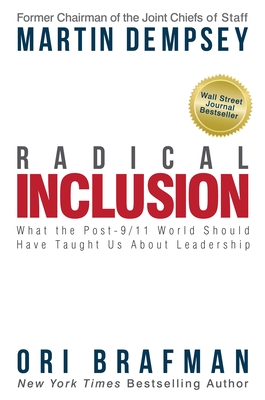
Radical Inclusion : What the Post-9/11 World Should Have Taught Us About Leadership
Book Details
Format
Hardback
ISBN-10
1939714109
ISBN-13
9781939714107
Publisher
Missionday
Imprint
Missionday
Country of Manufacture
US
Country of Publication
GB
Publication Date
Apr 19th, 2018
Print length
192 Pages
Weight
400 grams
Dimensions
21.60 x 14.40 x 2.10 cms
Product Classification:
Management: leadership & motivationManagement: leadership and motivation
KSh 3,600.00
Re-Printing
0 in stock
Delivery Location
Delivery fee: Select location
Secure
Quality
Fast
A WALL STREET JOURNAL BEST-SELLING BOOK
NAMED BY THE WASHINGTON POST AS ONE OF THE 11 LEADERSHIP BOOKS TO READ IN 2018
Radical Inclusion: What the Post-9/11 World Should Have Taught Us About Leadership examines today’s leadership landscape and describes the change it demands of leaders. Dempsey and Brafman persuasively explain that today’s leaders are in competition for the trust and confidence of those they lead more than ever before. They assert that the nature of power is changing and should not be measured by degree of control alone. They offer principles for adaptation and bring them to life with examples from business, academia, government, and the military.
In building their argument, Dempsey and Brafman introduce several concepts that illuminate both the vulnerability and the opportunity in leading today:
The principles discussed in Radical Inclusion are memorable and the book is full of engaging stories. From a young vegan’s confrontation with opponents in Berkeley to a young lieutenant’s surprising visitor during the Cold War, from a reflection on the significance of Burning Man to a discussion of challenges faced in the Situation Room, Radical Inclusion will provide you with leadership tools to address real leadership challenges.
NAMED BY THE WASHINGTON POST AS ONE OF THE 11 LEADERSHIP BOOKS TO READ IN 2018
Radical Inclusion: What the Post-9/11 World Should Have Taught Us About Leadership examines today’s leadership landscape and describes the change it demands of leaders. Dempsey and Brafman persuasively explain that today’s leaders are in competition for the trust and confidence of those they lead more than ever before. They assert that the nature of power is changing and should not be measured by degree of control alone. They offer principles for adaptation and bring them to life with examples from business, academia, government, and the military.
In building their argument, Dempsey and Brafman introduce several concepts that illuminate both the vulnerability and the opportunity in leading today:
- Radical Inclusion. Fear of losing control in our fast-paced, complex, highly scrutinized environment is pushing us toward exclusion?exactly the wrong direction. Leaders should instead develop an instinct for inclusion. The word “radical” emphasizes the urgency of doing so.
- The Era of the Digital Echo. The speed and accessibility of information create “digital echoes” that make facts vulnerable, eroding the trust between leader and follower.
- Relinquishing Control to Preserve Power. Power and control once went hand in hand, but no longer. In today’s environment, control is seductive but unlikely to produce optimum, affordable, sustainable solutions. Leaders must relinquish and share control to build and preserve power.
The principles discussed in Radical Inclusion are memorable and the book is full of engaging stories. From a young vegan’s confrontation with opponents in Berkeley to a young lieutenant’s surprising visitor during the Cold War, from a reflection on the significance of Burning Man to a discussion of challenges faced in the Situation Room, Radical Inclusion will provide you with leadership tools to address real leadership challenges.
Get Radical Inclusion by Martin Dempsey, Ori Brafman at the best price and quality guaranteed only at Werezi Africa's largest book ecommerce store. The book was published by Missionday and it has 192 pages.
Customers Who Bought This Also Bought

Trump: The Art of the Deal
KSh 2,700.00

Atlas of the Heart
KSh 4,950.00

Drive
KSh 2,000.00

Harvard Business Review Manager''s Handbook
KSh 4,150.00

Skin in the Game
KSh 2,350.00

Leading
KSh 2,700.00

The Upside of Uncertainty
KSh 4,500.00

The Concise Laws of Human Nature
KSh 2,000.00
The Ultimate Guide to Developing Leaders
KSh 2,350.00
The 21 Irrefutable Laws of Leadership
KSh 2,700.00

How Boards Work
KSh 2,350.00

Staying True to You
KSh 2,700.00