
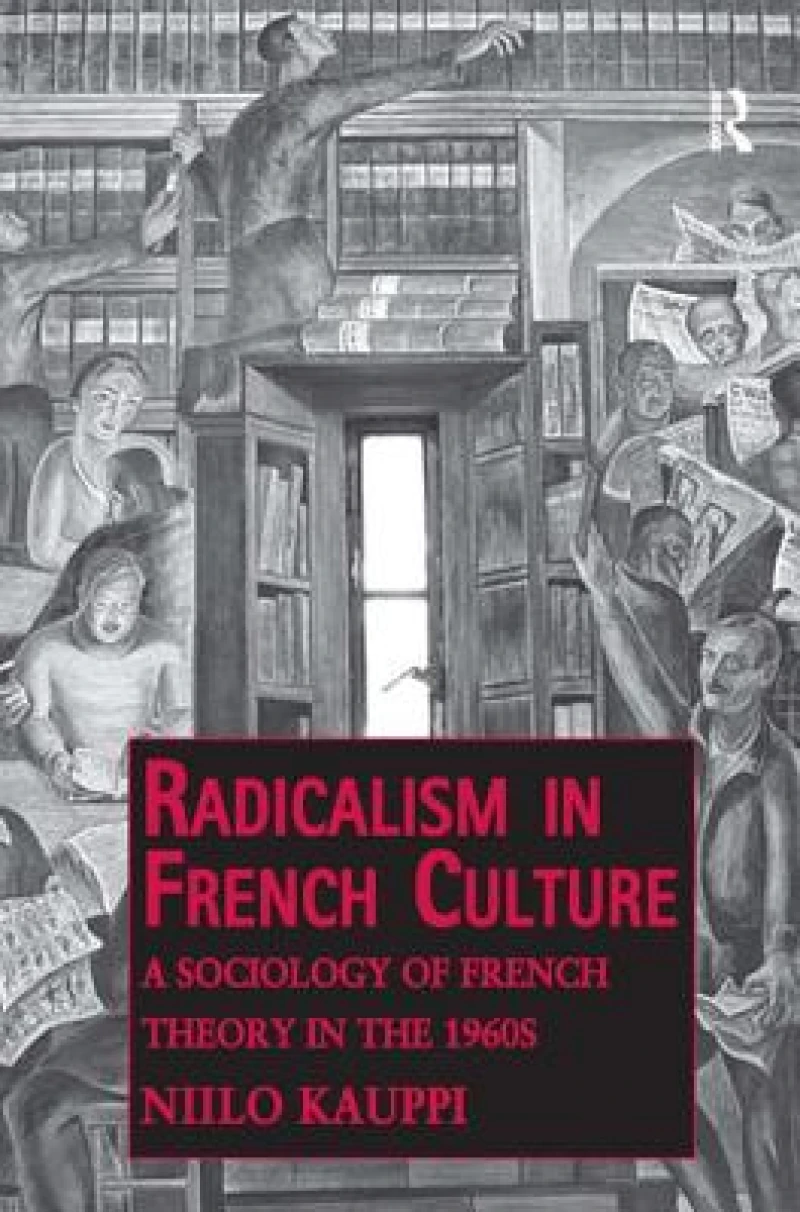
Radicalism in French Culture : A Sociology of French Theory in the 1960s
by
Niilo Kauppi
Book Details
Format
Hardback or Cased Book
ISBN-10
1409407837
ISBN-13
9781409407836
Publisher
Taylor & Francis Ltd
Imprint
Routledge
Country of Manufacture
GB
Country of Publication
GB
Publication Date
Nov 11th, 2010
Print length
164 Pages
Weight
453 grams
Product Classification:
Cultural studiesSocial theory
Ksh 30,950.00
Werezi Extended Catalogue
0 in stock
Delivery Location
Delivery fee: Select location
Secure
Quality
Fast
Shows that the defining but largely neglected feature of what has become 'French theory' was a collective mind and style of thought, an explosive but fragile mixture of scientific and political radicalism that rather quickly watered down to academic orthodoxy.
An invisible pattern draws together most studies dealing with French cultural radicalism in the 1960s with intellectual creation reduced to individual creation and the role of semiotic and social factors that influence intellectual innovation minimized. Sociological approaches often see a more or less external link between social location and intellectual production but, because of their structural approach, they are incapable of taking into account unique historical circumstances, the crucial role of personal impulses, and more importantly the semiotic logic of ideas as conditions of innovative thinking. This ground-breaking book will further an internal sociological analysis of ideas and styles of thought. It will show that the defining but largely neglected feature of what has become "French theory" was a collective mind and style of thought, an explosive but fragile mixture of scientific and political radicalism that rather quickly watered down to academic orthodoxy. For some time, radical intellectuals succeeded in producing ideas that were perfectly in tune with the demands of the consumers, mostly the young university audience. Ideas were used as part of radical posture that was set in opposition to the establishment and "those in power". Ideas could not be too empirical or verifiable, and they had to shock. It is not surprising that a slew of new sciences and concepts were invented to indicate this radical posture. The central argument of this study is that ideas become "power-ideas" only if they succeed in uniting individual and collective psychic investment in powerful social networks with significant institutional and political backing. These conditions were met in the French context for a certain specific period of time. From roughly the mid-1960s to the beginning of the 1970s, radical intellectuals such as Roland Barthes, Pierre Bourdieu, Jacques Derrida, Michel Foucault, Julia Kristeva developed a host of new ideas, concepts and theories, a number of which have subsequently been labelled as French theory.
Get Radicalism in French Culture by at the best price and quality guaranteed only at Werezi Africa's largest book ecommerce store. The book was published by Taylor & Francis Ltd and it has pages.

