
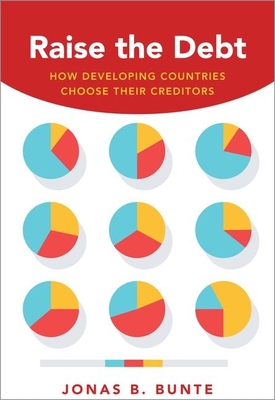
Raise the Debt : How Developing Countries Choose Their Creditors
Book Details
Format
Paperback / softback
ISBN-10
0190866179
ISBN-13
9780190866174
Publisher
Oxford University Press Inc
Imprint
Oxford University Press Inc
Country of Manufacture
GB
Country of Publication
GB
Publication Date
Mar 21st, 2019
Print length
296 Pages
Weight
458 grams
Dimensions
23.30 x 15.50 x 1.90 cms
Product Classification:
Comparative politicsInternational economicsPolitical economy
KSh 6,150.00
Temporarily out of stock, due soon
0 in stock
Delivery Location
Delivery fee: Select location
Secure
Quality
Fast
Why do some governments borrow from China, while others borrow from the United States or the International Monetary Fund (IMF)? This book systematically explains how governments choose among competing loan offers. As the strings attached to loans vary across creditors, domestic interest groups prefer one type of creditor to the other. However, interest groups disagree about which creditor is preferable. Governments cater to whichever domestic interest group coalition is dominant by borrowing from the coalition''s preferred creditor. The book offers evidence from Ecuador, Peru, and Colombia as well as an extensive statistical analysis. The results show that borrowing portfolios around the world reflect the relative strength of societal interest groups.
Credit is the lifeblood of capitalism and development. Brazil, Russia, India, and China-also called BRICs-have become important creditors to developing countries. However, how will their loans affect economic development and democracy in recipient countries? We need to understand why governments accept Chinese over Western loan offers before we can predict their likely consequences. In Raise the Debt, Jonas B. Bunte systematically explains how governments choose among competing loan offers. Using statistical analyses and extensive interview data, he shows that the strings attached to loans vary across creditors. Consequently, one domestic interest group may benefit from Chinese credit but not U.S. loans, while the opposite is the case for other groups. Bunte provides evidence that governments cater to whichever domestic interest group is politically dominant when deciding between competing loan offers. Combining a comparative politics approach with international political economy methods, Raise the Debt shows how a deeper understanding of governments'' borrowing decisions is critical for gaining insights into how these loans could impact growth and democracy on a global scale.
Get Raise the Debt by Jonas B. Bunte at the best price and quality guaranteed only at Werezi Africa's largest book ecommerce store. The book was published by Oxford University Press Inc and it has 296 pages.
Customers Who Bought This Also Bought

Age of Revolutions
KSh 2,350.00

How Civil Wars Start
KSh 2,000.00

Autobiography
KSh 2,350.00

The Origins of Political Order
KSh 2,700.00
Summer of Our Discontent
KSh 4,500.00

Political Order and Political Decay
KSh 2,700.00

Great Power Diplomacy
KSh 5,400.00

Summer of Our Discontent
KSh 2,350.00

Narrow Corridor
KSh 2,350.00

Israel’s Palestinians
KSh 4,700.00

Order and Region Making in the Middle East
KSh 17,100.00

Nasser's Blessed Movement
KSh 3,400.00
