
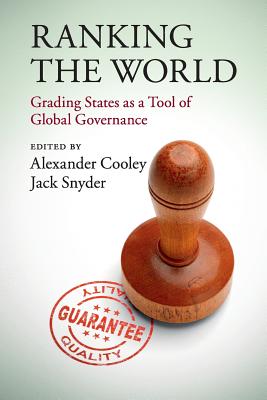
Ranking the World : Grading States as a Tool of Global Governance
Book Details
Format
Paperback / softback
ISBN-10
110748412X
ISBN-13
9781107484122
Publisher
Cambridge University Press
Imprint
Cambridge University Press
Country of Manufacture
GB
Country of Publication
GB
Publication Date
Oct 20th, 2016
Print length
256 Pages
Weight
380 grams
Dimensions
15.40 x 22.90 x 1.80 cms
Product Classification:
Comparative politicsInternational relationsPolitical economy
KSh 6,200.00
Currently unavailable
0 in stock
Delivery Location
Delivery fee: Select location
Secure
Quality
Fast
Global actors publicly rank state performance in areas such as corruption, quality of democracy, creditworthiness, media openness and/or business environment. These international rankings always carry value judgments, methodological choices, and political agendas. This volume addresses the theoretical, normative and policy issues associated with 'grading states'.
Over the last decade, international rankings have emerged as a critical tool used by international actors engaged in global governance. State practices and performance are now judged by a number of high-profile indices, including assessments of their levels of corruption, quality of democracy, creditworthiness, media freedom, and business environment. However, these rankings always carry value judgments, methodological choices, and implicit political agendas. This volume expertly addresses the important analytical, normative, and policy issues associated with the contemporary practice of 'grading states'. The chapters explore how rankings affect our perceptions of state performance, how states react to being ranked, why some rankings exert more global influence than others, and how states have come to strategize and respond to these public judgments. The book also critically examines how treating state rankings like popular consumer choice indices may actually lead policymakers to internalize questionable normative assumptions and lead to poorer, not improved, public policy outcomes.
Get Ranking the World by Alexander Cooley at the best price and quality guaranteed only at Werezi Africa's largest book ecommerce store. The book was published by Cambridge University Press and it has 256 pages.
Customers Who Bought This Also Bought

Age of Revolutions
KSh 2,350.00

How Civil Wars Start
KSh 2,000.00

Autobiography
KSh 2,350.00

The Origins of Political Order
KSh 2,700.00
Summer of Our Discontent
KSh 4,500.00

Political Order and Political Decay
KSh 2,700.00

Great Power Diplomacy
KSh 5,400.00

Summer of Our Discontent
KSh 2,350.00

Narrow Corridor
KSh 2,350.00
Israel’s Palestinians
KSh 4,700.00

Order and Region Making in the Middle East
KSh 17,100.00

Nasser's Blessed Movement
KSh 3,400.00
