
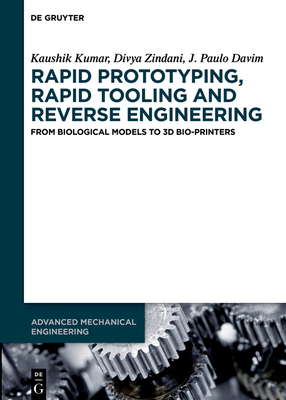
Rapid Prototyping, Rapid Tooling and Reverse Engineering : From Biological Models to 3D Bioprinters
Book Details
Delivery Location
Delivery fee: Select location
This book introduces the role of Rapid Prototyping Techniques within the product development phase. It deals with the concept, origin, and working cycle of Rapid Prototyping Processes with emphasis on the applications. Apart from elaboration of engineering and non-engineering applications, it highlights recent applications like Bio-Medical Models for Surgical Planning, Molecular Models, Architectural Models, Sculptured Models, Psycho-Analysis Models. Special emphasis has been provided to the technique of generating human organs from live cells/tissues of the same human named 3D BIO PRINTERS. As the Rapid Prototyping Techniques are for tailor made products and not for mass manufacturing hence the book also elaborates on the mass manufacturing of rapid prototyped products. This includes casting and rapid tooling. The book concludes with Reverse Engineering and the role played by Rapid Prototyping Techniques towards the same.
With globalization of market and advances in science and technology, the life span of products has shortened considerably. For early realization of products and short development period, engineers and researchers are constantly working together for more and more efficient and effective solutions. The most effective solution identified has been usage of computers in both designing and manufacturing. This gave birth to the nomenclatures CAD (Computer Aided Designing) and CAM (Computer aided Manufacturing). This was the initiation that ensured short product development and realization period. Researchers coined the concept as Rapid Prototyping. In contrast to Prototyping, Rapid prototyping is a group of techniques used to quickly fabricate a scale model of a physical part or assembly using three-dimensional computer aided design (CAD) data. Construction of the part or assembly is usually done using 3D printing or "additive or subtractive layer manufacturing" technology.The first methods for rapid prototyping became available in the late 1980s and were used to produce models and prototype parts. Today, they are used for a wide range of applications and are used to manufacture production-quality parts in relatively small numbers if desired without the typical unfavorable short-run economics. This economy has encouraged online service bureaus for early product realization or physical products for actual testing.
This book is expected to contain Seven Chapters. Chapter 1 would explain product life cycle and the product development phase in the same, introducing role of Rapid Prototyping Techniques in Product development phase. Chapter 2 would deals with the concept, origin and working cycle of Rapid Prototyping Processes. Chapter 3 would concentrates on the applications of Rapid Prototyping Technology. Apart from elaboration of engineering and non-engineering applications, it also elaborates on recent applications like Bio-Medical Models for Surgical Planning, Molecular Models, Architectural Models, Sculptured Models, Psycho-Analysis Models etc. Chapter 4 would introduce the various Rapid Prototyping systems available worldwide. The chapter also introduces the technique of generating human organs from live cells/tissues of the same human named 3D BIO PRINTERS hence ensuring low rejection rate by human body. As the Rapid Prototyping Techniques are for tailor made products and not for mass manufacturing hence Chapter 5 would elaborates on the mass manufacturing of rapid prototyped products. This includes Casting and Rapid Tooling. Chapter 6 would deal with Reverse Engineering and the role played by Rapid Prototyping Techniques towards the same. As the product realization is primarily dependent on various softwares which are required to be understood for better accuracy so the concluding chapter of the book i.e. Chapter 7 would explain some software associated with the various techniques.Get Rapid Prototyping, Rapid Tooling and Reverse Engineering by Divya Zindani, J. Paulo Davim at the best price and quality guaranteed only at Werezi Africa's largest book ecommerce store. The book was published by De Gruyter and it has 173 pages.
Customers Who Bought This Also Bought

Thermomechanical Pulp
KSh 16,750.00

Sustainable Advanced Manufacturing and Materials Processing
KSh 9,200.00

Applied Reliability, Usability, and Quality for Engineers
KSh 26,300.00

Thermal Energy Storage
KSh 25,200.00

Advance Solar Photovoltaic Thermal Energy Technologies
KSh 23,400.00

Blechformung
KSh 22,250.00

Schutz vor Produktpiraterie
KSh 9,900.00

Industrial Separation Processes
KSh 14,750.00

Serviceroboter
KSh 5,050.00

Advances in Production Management Systems. Initiatives for a Sustainable World
KSh 23,400.00

Methodisches Konstruieren von additiv gefertigten Bauteilen
KSh 7,200.00

ERP und SCM
KSh 14,550.00
More by Divya Zindani, J. Paulo Davim
Mastering SolidWorks
KSh 28,800.00

Advanced Machining and Manufacturing Processes
KSh 16,200.00

Smart Materials
KSh 15,850.00

Advanced Welding Engineering and Technology for Marine Applications
KSh 14,750.00

Statistical Modelling and Analysis of Fused Deposition Modelling Process Parameters for Green Composites Fabrication
KSh 10,100.00

Drones
KSh 20,700.00

CNC Programming for Machining
KSh 28,800.00

CNC Programming for Machining
KSh 28,800.00
Mastering SolidWorks
KSh 28,800.00

Engineering Materials Characterization
KSh 16,400.00

A Brief History of Mechanical Engineering
KSh 21,600.00

Advanced Machining and Manufacturing Processes
KSh 21,600.00
More in This Genre
Thermomechanical Pulp
KSh 16,750.00
Sustainable Advanced Manufacturing and Materials Processing
KSh 9,200.00
Applied Reliability, Usability, and Quality for Engineers
KSh 26,300.00
Thermal Energy Storage
KSh 25,200.00
Advance Solar Photovoltaic Thermal Energy Technologies
KSh 23,400.00
Blechformung
KSh 22,250.00
