
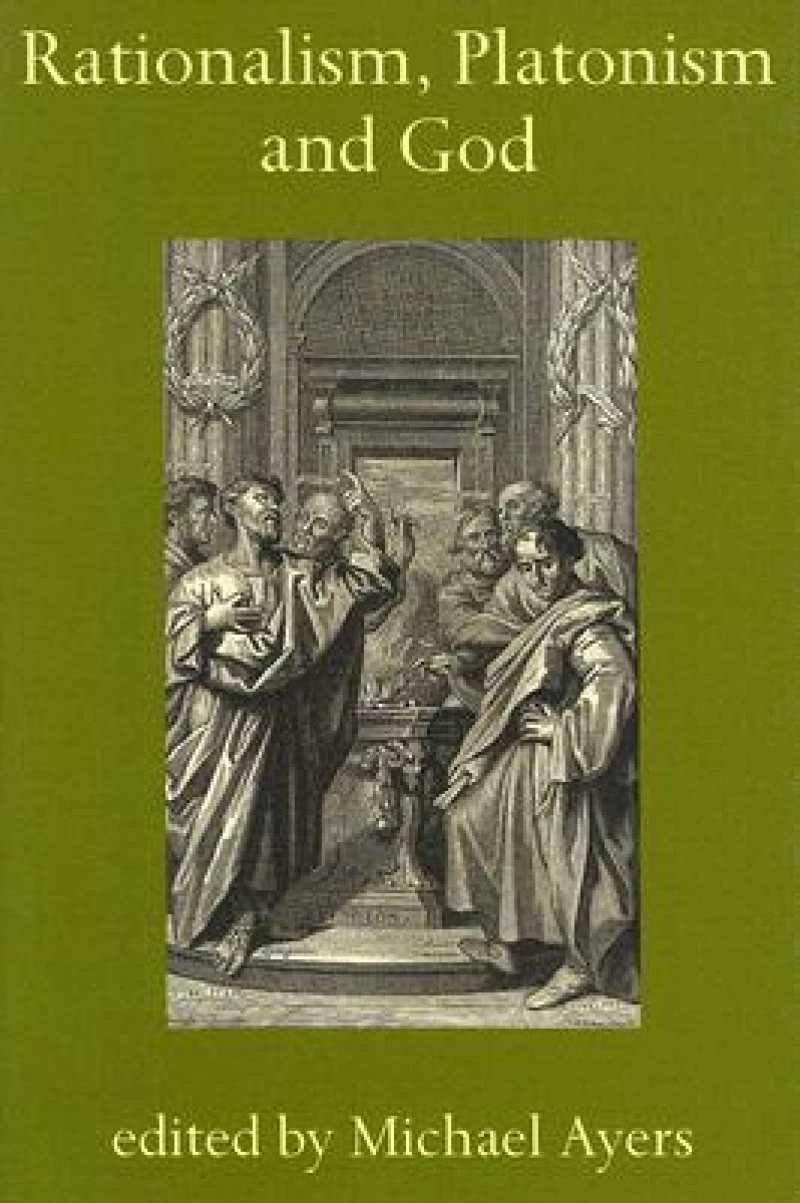
Rationalism, Platonism and God
Book Details
Format
Hardback or Cased Book
Book Series
Proceedings of the British Academy
ISBN-10
0197264204
ISBN-13
9780197264201
Publisher
Oxford University Press
Imprint
Oxford University Press
Country of Manufacture
GB
Country of Publication
GB
Publication Date
Dec 27th, 2007
Print length
154 Pages
Weight
430 grams
Dimensions
16.50 x 38.50 x 1.80 cms
Product Classification:
Western philosophy: c 1600 to c 1900Philosophical traditions and schools of thought
Ksh 7,150.00
Werezi Extended Catalogue
0 in stock
Delivery Location
Delivery fee: Select location
Secure
Quality
Fast
This volume comprises three main papers on Descartes, Spinoza, and Leibniz, with extensive responses. It provides a significant contribution to the exploration of the common ground of the great early-modern Rationalist theories, and an examination of the ways in which the mainstream Platonic tradition permeates these theories.
Rationalism, Platonism and God comprises three main papers on Descartes, Spinoza and Leibniz, with extensive responses. It provides a significant contribution to the exploration of the common ground of the great early-modern Rationalist theories, and an examination of the ways in which the mainstream Platonic tradition permeates these theories. John Cottingham identifies characteristically Platonic themes in Descartes''s cosmology and metaphysics, finding them associated with two distinct, even opposed attitudes to nature and the human condition, one ancient and ''contemplative'', the other modern and ''controlling''. He finds the same tension in Descartes''s moral theory, and believes that it remains unresolved in present-day ethics.Was Spinoza a Neoplatonist theist, critical Cartesian, or naturalistic materialist? Michael Ayers argues that he was all of these. Analysis of his system reveals how Spinoza employed Neoplatonist monism against Descartes''s Platonist pluralism. Yet the terminology - like the physics - is Cartesian. And within this Platonic-Cartesian shell Spinoza developed a rigorously naturalistic metaphysics and even, Ayers claims, an effectually empiricist epistemology.Robert Merrihew Adams focuses on the Rationalists'' arguments for the Platonist, anti-Empiricist principle of ''the priority of the perfect'', i.e. the principle that finite attributes are to be understood through corresponding perfections of God, rather than the reverse. He finds the given arguments unsatisfactory but stimulating, and offers a development of one of Leibniz''s for consideration. These papers receive informed and constructive criticism and development at the hands of, respectively, Douglas Hedley, Sarah Hutton and Maria Rosa Antognazza.
Get Rationalism, Platonism and God by at the best price and quality guaranteed only at Werezi Africa's largest book ecommerce store. The book was published by Oxford University Press and it has pages.

