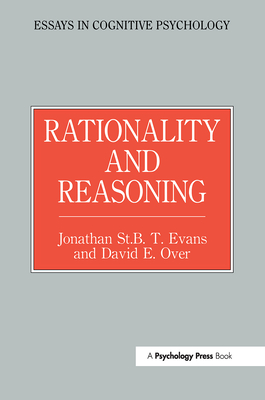
Rationality and Reasoning
Book Details
Format
Paperback / Softback
Book Series
Essays in Cognitive Psychology
ISBN-10
0863774385
ISBN-13
9780863774386
Publisher
Taylor & Francis Ltd
Imprint
Psychology Press Ltd
Country of Manufacture
GB
Country of Publication
GB
Publication Date
Jun 17th, 1999
Print length
192 Pages
Weight
282 grams
Dimensions
22.80 x 15.10 x 1.10 cms
Product Classification:
Intelligence & reasoning
Ksh 9,900.00
Werezi Extended Catalogue
Delivery in 28 days
Delivery Location
Delivery fee: Select location
Delivery in 28 days
Secure
Quality
Fast
Addresses an apparent paradox in the psychology of thinking. Topics discussed include relevance effects in reasoning and decision making, the influence of prior beliefs on thinking, and if non-logical reasoning can affect decison making.
This book addresses an apparent paradox in the psychology of thinking. On the one hand, human beings are a highly successful species. On the other, intelligent adults are known to exhibit numerous errors and biases in laboratory studies of reasoning and decision making. There has been much debate among both philosophers and psychologists about the implications of such studies for human rationality. The authors argue that this debate is marked by a confusion between two distinct notions: (a) personal rationality (rationality1
Evans and Over argue that people have a high degree of rationality1 but only a limited capacity for rationality2. The book re-interprets the psychological literature on reasoning and decision making, showing that many normative errors, by abstract standards, reflect the operation of processes that would normally help to achieve ordinary goals. Topics discussed include relevance effects in reasoning and decision making, the influence of prior beliefs on thinking, and the argument that apparently non-logical reasoning can reflect efficient decision making. The authors also discuss the problem of deductive competence - whether people have it, and what mechanism can account for it.
As the book progresses, increasing emphasis is given to the authors'' dual process theory of thinking, in which a distinction between tacit and explicit cognitive systems is developed. It is argued that much of human capacity for rationality1 is invested in tacit cognitive processes, which reflect both innate mechanisms and biologically constrained learning. However, the authors go on to argue that human beings also possess an explicit thinking system, which underlies their unique - if limited - capacity to be rational.
Evans and Over argue that people have a high degree of rationality1 but only a limited capacity for rationality2. The book re-interprets the psychological literature on reasoning and decision making, showing that many normative errors, by abstract standards, reflect the operation of processes that would normally help to achieve ordinary goals. Topics discussed include relevance effects in reasoning and decision making, the influence of prior beliefs on thinking, and the argument that apparently non-logical reasoning can reflect efficient decision making. The authors also discuss the problem of deductive competence - whether people have it, and what mechanism can account for it.
As the book progresses, increasing emphasis is given to the authors'' dual process theory of thinking, in which a distinction between tacit and explicit cognitive systems is developed. It is argued that much of human capacity for rationality1 is invested in tacit cognitive processes, which reflect both innate mechanisms and biologically constrained learning. However, the authors go on to argue that human beings also possess an explicit thinking system, which underlies their unique - if limited - capacity to be rational.
Get Rationality and Reasoning by at the best price and quality guaranteed only at Werezi Africa's largest book ecommerce store. The book was published by Taylor & Francis Ltd and it has pages.