
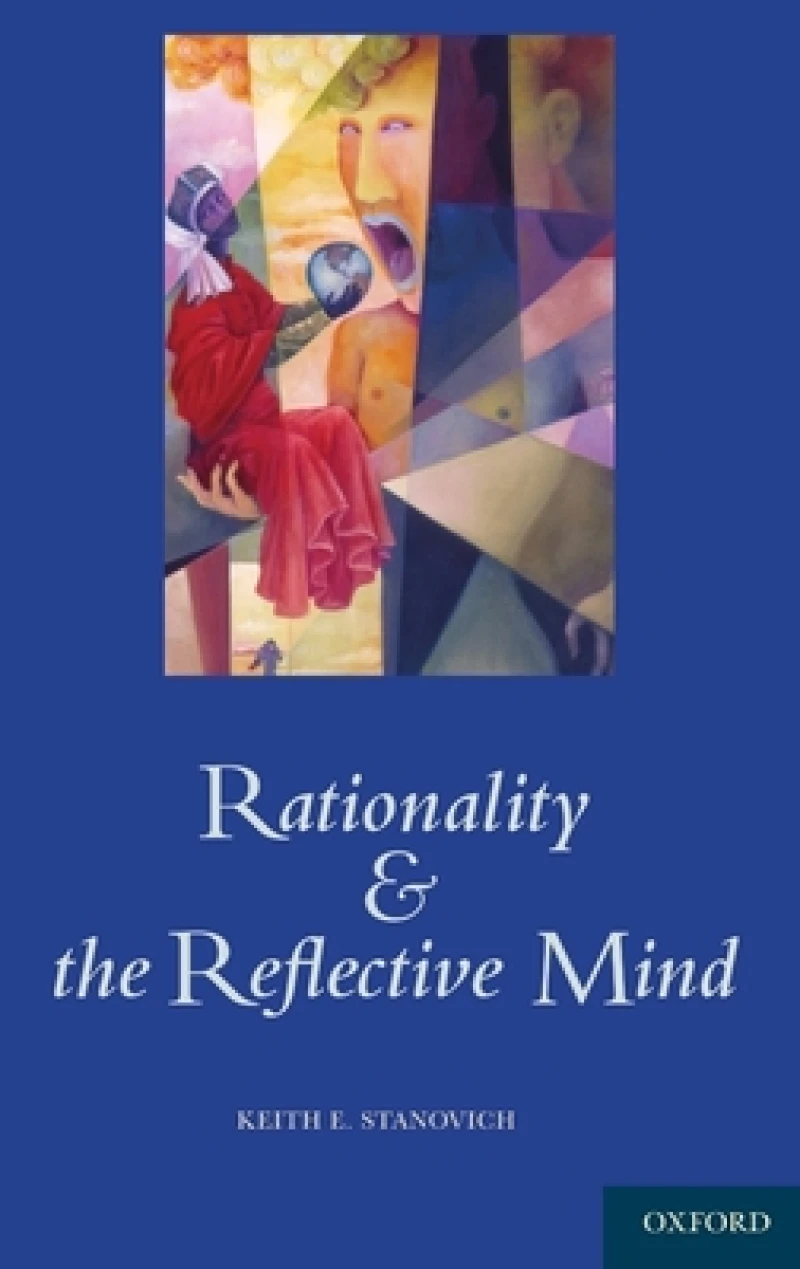
Rationality and the Reflective Mind
Book Details
Format
Hardback or Cased Book
ISBN-10
0195341147
ISBN-13
9780195341140
Publisher
Oxford University Press Inc
Imprint
Oxford University Press Inc
Country of Manufacture
US
Country of Publication
GB
Publication Date
Feb 3rd, 2011
Print length
344 Pages
Weight
646 grams
Dimensions
24.40 x 17.40 x 2.20 cms
Product Classification:
PsychologySocial, group or collective psychology
Ksh 21,600.00
Manufactured on Demand
0 in stock
Delivery Location
Delivery fee: Select location
Secure
Quality
Fast
In this book, Keith Stanovich attempts to resolve the Great Rationality Debate in cognitive science-the debate about how much irrationality to ascribe to human cognition. Stanovich shows how the insights of dual-process theory and evolutionary psychology can be combined to explain why humans are sometimes irrational even though they possess cognitive machinery of remarkable adaptiveness. Using a unique individual differences approach, Stanovich shows that to fully characterize differences in rational thinking, the traditional System 2 of dual-process theory must be partitioned into the reflective mind and the algorithmic mind. Using a new tripartite model of mind, Stanovich shows how rationality is a more encompassing construct than intelligence-when both are properly defined-and that IQ tests fail to assess individual differences in rational thought. Stanovich discusses the types of thinking processes that would be measured in an assessment of rational thinking.
In Rationality and the Reflective Mind, Keith Stanovich attempts to resolve the Great Rationality Debate in cognitive science--the debate about how much irrationality to ascribe to human cognition. He shows how the insights of dual-process theory and evolutionary psychology can be combined to explain why humans are sometimes irrational even though they possess remarkably adaptive cognitive machinery. Stanovich argues that to fully characterize differences in rational thinking, we need to replace dual-process theories with tripartite models of cognition. Using a unique individual differences approach, he shows that the traditional second system (System 2) of dual-process theory must be further divided into the reflective mind and the algorithmic mind. Distinguishing them will allow us to better appreciate the significant differences in their key functions: The key function of the reflective mind is to detect the need to interrupt autonomous processing and to begin simulation activities, whereas that of the algorithmic mind is to sustain the processing of decoupled secondary representations in cognitive simulation. Stanovich then uses this algorithmic/reflective distinction to develop a taxonomy of cognitive errors made on tasks in the heuristics and biases literature. He presents the empirical data to show that the tendency to make these thinking errors is not highly related to intelligence. Using his tripartite model of cognition, Stanovich shows how, when both are properly defined, rationality is a more encompassing construct than intelligence, and that IQ tests fail to assess individual differences in rational thought. He then goes on to discuss the types of thinking processes that would be measured if rational thinking were to be assessed as IQ has been.
Get Rationality and the Reflective Mind by at the best price and quality guaranteed only at Werezi Africa's largest book ecommerce store. The book was published by Oxford University Press Inc and it has pages.

