
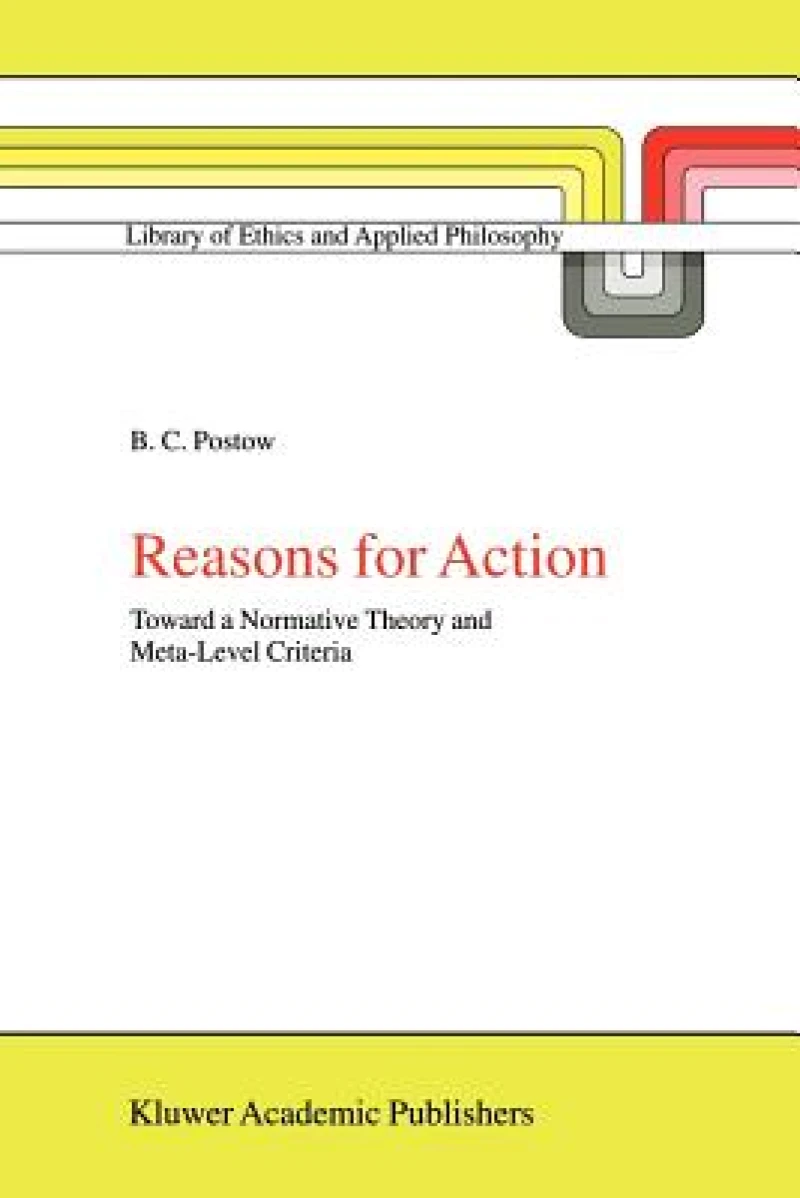
Reasons for Action : Toward a Normative Theory and Meta-Level Criteria
Softcover reprint of hardcover 1st ed. 1999
by
B.C. Postow
Book Details
Format
Paperback / Softback
Book Series
Library of Ethics and Applied Philosophy
ISBN-10
9048152194
ISBN-13
9789048152193
Edition
Softcover reprint of hardcover 1st ed. 1999
Publisher
Springer
Imprint
Springer
Country of Manufacture
GB
Country of Publication
GB
Publication Date
Dec 8th, 2010
Print length
205 Pages
Weight
342 grams
Dimensions
15.40 x 23.40 x 1.70 cms
Product Classification:
Philosophy: metaphysics & ontologyPhilosophy: logicPhilosophy of mindEthics & moral philosophy
Ksh 16,200.00
Werezi Extended Catalogue
0 in stock
Delivery Location
Delivery fee: Select location
Secure
Quality
Fast
2 first-person point of view, I acknowledge these possible handicaps and try to overcome them. Other people may coherently judge that I am incapable of figuring out correctly what I rationally ought to do, or they may inform me of reasons of which I had heretofore been ignorant, or they may try to help me overcome intellectual hindrances. Like me, these people would be assuming that the goal is to identify what I really rationally ought to do. Nevertheless, we are concerned with reasons for the agent to act in a certain way, rather than with reasons, say, for someone to want it to be the case that the agent act. Thus to be a reason in our sense is to be a consideration which has an appropriate guiding role to play in the. agents deliberation. (An agent is guided by reasons if she determines what to do in light of the reasons. ) Suppose then that a nor mative theory says that it is supremely desirable, or that it rationally ought to be the case, that agents act in a way that maximizes the general utility, but that (since the general utility is never in fact maximized by those who pay attention to it) considerations of the general utility should play no role in the agents' deliberation. Such a theory would not be said to ascribe to agents a reason to maximize the general utility on our usage.
2 first-person point of view, I acknowledge these possible handicaps and try to overcome them. Other people may coherently judge that I am incapable of figuring out correctly what I rationally ought to do, or they may inform me of reasons of which I had heretofore been ignorant, or they may try to help me overcome intellectual hindrances. Like me, these people would be assuming that the goal is to identify what I really rationally ought to do. Nevertheless, we are concerned with reasons for the agent to act in a certain way, rather than with reasons, say, for someone to want it to be the case that the agent act. Thus to be a reason in our sense is to be a consideration which has an appropriate guiding role to play in the. agents deliberation. (An agent is guided by reasons if she determines what to do in light of the reasons. ) Suppose then that a nor mative theory says that it is supremely desirable, or that it rationally ought to be the case, that agents act in a way that maximizes the general utility, but that (since the general utility is never in fact maximized by those who pay attention to it) considerations of the general utility should play no role in the agents'' deliberation. Such a theory would not be said to ascribe to agents a reason to maximize the general utility on our usage.
Get Reasons for Action by at the best price and quality guaranteed only at Werezi Africa's largest book ecommerce store. The book was published by Springer and it has pages.

