
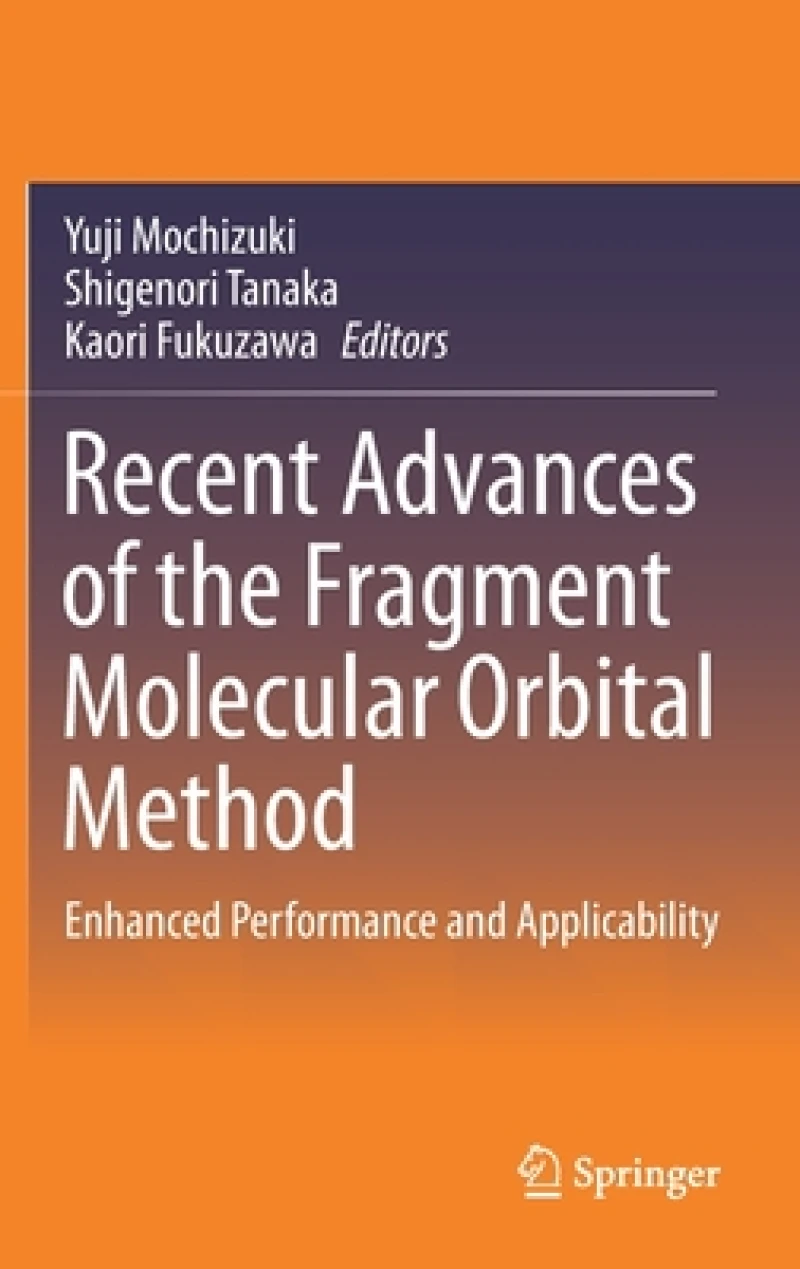
Recent Advances of the Fragment Molecular Orbital Method : Enhanced Performance and Applicability
2021 ed.
Book Details
Format
Hardback or Cased Book
ISBN-10
9811592349
ISBN-13
9789811592348
Edition
2021 ed.
Publisher
Springer Verlag, Singapore
Imprint
Springer Verlag, Singapore
Country of Manufacture
GB
Country of Publication
GB
Publication Date
Jan 5th, 2021
Print length
616 Pages
Weight
1,058 grams
Dimensions
16.10 x 24.60 x 4.20 cms
Ksh 23,400.00
Werezi Extended Catalogue
0 in stock
Delivery Location
Delivery fee: Select location
Secure
Quality
Fast
This book covers recent advances of the fragment molecular orbital (FMO) method, consisting of 5 parts and a total of 30 chapters written by FMO experts.
This book covers recent advances of the fragment molecular orbital (FMO) method, consisting of 5 parts and a total of 30 chapters written by FMO experts. The FMO method is a promising way to calculate large-scale molecular systems such as proteins in a quantum mechanical framework. The highly efficient parallelism deserves being considered the principal advantage of FMO calculations. Additionally, the FMO method can be employed as an analysis tool by using the inter-fragment (pairwise) interaction energies, among others, and this feature has been utilized well in biophysical and pharmaceutical chemistry. In recent years, the methodological developments of FMO have been remarkable, and both reliability and applicability have been enhanced, in particular, for non-bio problems. The current trend of the parallel computing facility is of the many-core type, and adaptation to modern computer environments has been explored as well. In this book, a historical review of FMO and comparison to other methods are provided in Part I (two chapters) and major FMO programs (GAMESS-US, ABINIT-MP, PAICS and OpenFMO) are described in Part II (four chapters). dedicated to pharmaceutical activities (twelve chapters). A variety of new applications with methodological breakthroughs are introduced in Part IV (six chapters). Finally, computer and information science-oriented topics including massively parallel computation and machine learning are addressed in Part V (six chapters). Many color figures and illustrations are included. Readers can refer to this book in its entirety as a practical textbook of the FMO method or read only the chapters of greatest interest to them.
Get Recent Advances of the Fragment Molecular Orbital Method by at the best price and quality guaranteed only at Werezi Africa's largest book ecommerce store. The book was published by Springer Verlag, Singapore and it has pages.

