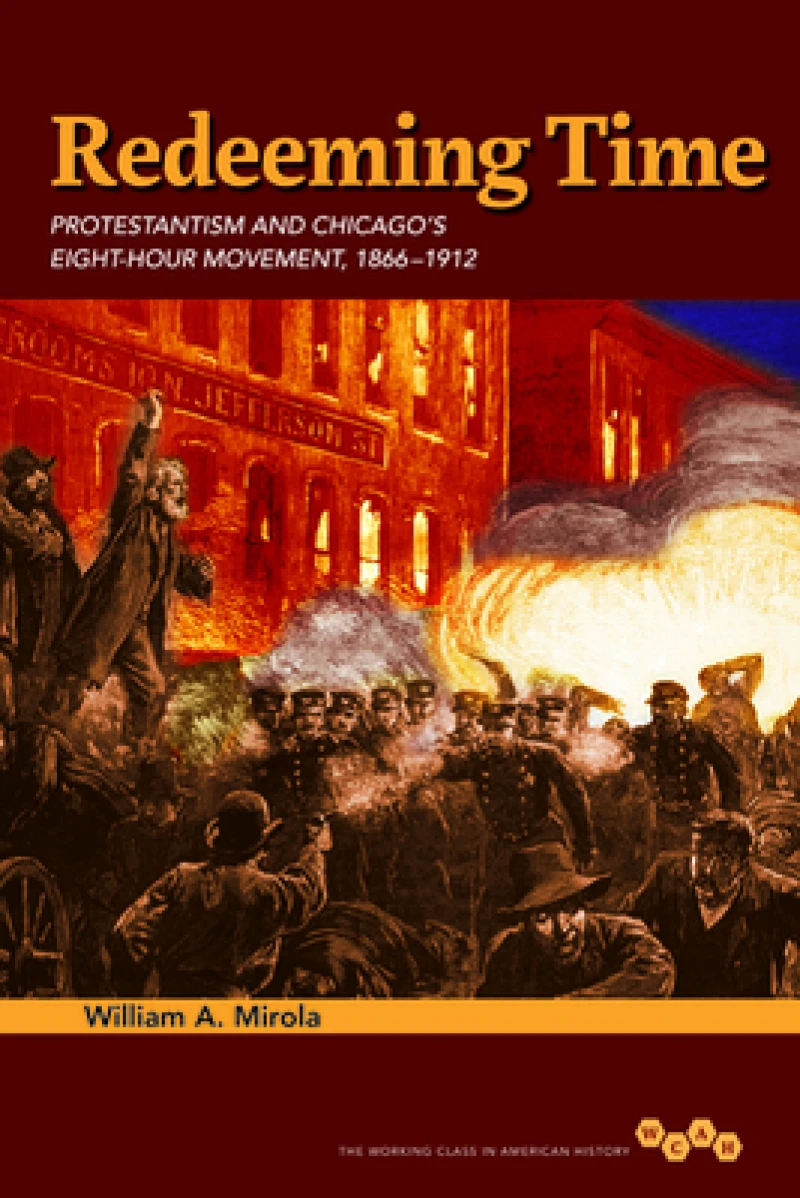
Redeeming Time : Protestantism and Chicago's Eight-Hour Movement, 1866-1912
Book Details
Format
Hardback or Cased Book
Book Series
Working Class in American History
ISBN-10
0252038835
ISBN-13
9780252038839
Publisher
University of Illinois Press
Imprint
University of Illinois Press
Country of Manufacture
US
Country of Publication
GB
Publication Date
Dec 3rd, 2014
Print length
240 Pages
Weight
540 grams
Dimensions
22.90 x 15.20 x 3.00 cms
Product Classification:
Religion & politicsSocial groups: religious groups and communitiesReligious groups: social & cultural aspectsCentral / national / federal government policiesCentral government policiesIndustrial relations, occupational health and safetyIndustrial relationsReligion and politics
Ksh 8,650.00
Werezi Extended Catalogue
0 in stock
Delivery Location
Delivery fee: Select location
Secure
Quality
Fast
Explores how the city's eight-hour movement intersected with a Protestant religious culture that supported long hours to keep workers from idleness, intemperance, and secular leisure activities.
During the struggle for the eight-hour workday and a shorter workweek, Chicago emerged as an important battleground for workers in "the entire civilized world" to redeem time from the workplace in order to devote it to education, civic duty, health, family, and leisure.
William A. Mirola explores how the city''s eight-hour movement intersected with a Protestant religious culture that supported long hours to keep workers from idleness, intemperance, and secular leisure activities. Analyzing how both workers and clergy rewove working-class religious cultures and ideologies into strategic and rhetorical frames, Mirola shows how every faith-based appeal contested whose religious meanings would define labor conditions and conflicts. As he notes, the ongoing worker-employer tension transformed both how clergy spoke about the eight-hour movement and what they were willing to do, until intensified worker protest and employer intransigence spurred Protestant clergy to support the eight-hour movement even as political and economic arguments eclipsed religious framing.
A revealing study of an era and a movement, Redeeming Time illustrates the potential--and the limitations--of religious culture and religious leaders as forces in industrial reform.
William A. Mirola explores how the city''s eight-hour movement intersected with a Protestant religious culture that supported long hours to keep workers from idleness, intemperance, and secular leisure activities. Analyzing how both workers and clergy rewove working-class religious cultures and ideologies into strategic and rhetorical frames, Mirola shows how every faith-based appeal contested whose religious meanings would define labor conditions and conflicts. As he notes, the ongoing worker-employer tension transformed both how clergy spoke about the eight-hour movement and what they were willing to do, until intensified worker protest and employer intransigence spurred Protestant clergy to support the eight-hour movement even as political and economic arguments eclipsed religious framing.
A revealing study of an era and a movement, Redeeming Time illustrates the potential--and the limitations--of religious culture and religious leaders as forces in industrial reform.
Get Redeeming Time by at the best price and quality guaranteed only at Werezi Africa's largest book ecommerce store. The book was published by University of Illinois Press and it has pages.