
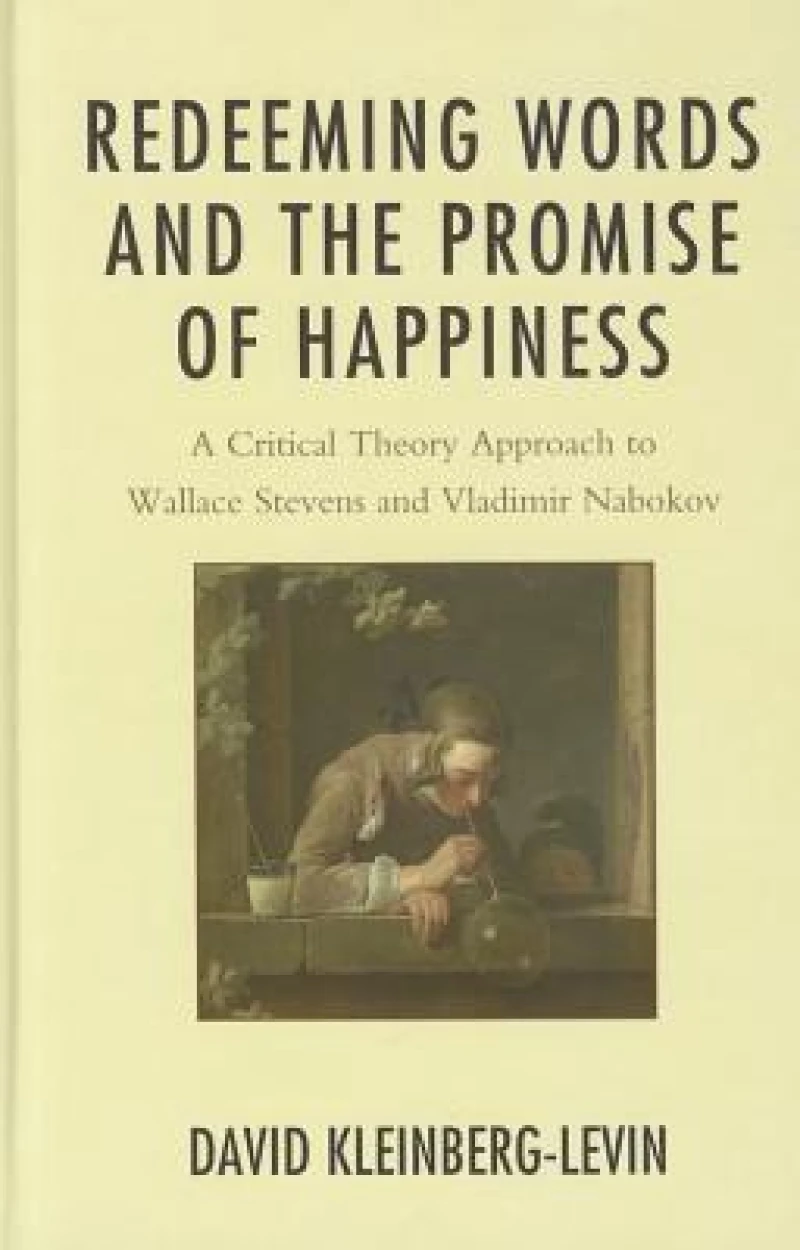
Redeeming Words and the Promise of Happiness : A Critical Theory Approach to Wallace Stevens and Vladimir Nabokov
Book Details
Format
Hardback or Cased Book
ISBN-10
0739177516
ISBN-13
9780739177518
Publisher
Bloomsbury Publishing Plc
Imprint
Lexington Books
Country of Manufacture
GB
Country of Publication
GB
Publication Date
Aug 31st, 2012
Print length
238 Pages
Weight
513 grams
Dimensions
23.50 x 15.80 x 2.30 cms
Product Classification:
Philosophy of languageLiterary theoryPhilosophyPhilosophy: aesthetics
Ksh 19,350.00
Manufactured on Demand
0 in stock
Delivery Location
Delivery fee: Select location
Secure
Quality
Fast
This book boldly crosses traditional academic boundaries, offering an original, philosophically informed argument about the nature of language, reading and interpreting the poetry of Wallace Stevens and the novels of Vladimir Nabokov. Redeeming Words and the Promise of Happiness is a work both in literary criticism and in philosophy. The approach is strongly influenced by Walter Benjamin’s philosophy of language and Theodor Adorno’s aesthetic theory, but the other philosophers—notably Plato, Kant, Hegel, Emerson, Nietzsche, Heidegger, and Wittgenstein—figure significantly in the reading and interpretation. Kleinberg-Levin argues that despite its damaged, corrupted condition, language is in its very existence the bearer of a utopian or messianic promise of happiness. Moreover, he argues, by reconciling sensuous sense and intelligible sense; showing the sheer power of words to create fictional worlds and deconstruct what they have just created; and redeeming the revelatory power of words—the power to turn the familiar into something astonishing, strange or perplexing—the two writers in this study sustain our hope for a world of reconciled antagonisms and contradictions, evoking in the way they freely play with the sounds and meanings of words, some intimations of a new world—but our world here, this very world, not some heavenly world—in which the promise of happiness might be redeemed. Reflecting on the poetry of Stevens, Kleinberg-Levin argues that the poet defies the correspondence theory of truth so that words may be faithful to truth as transformative and revelatory. He also argues that in the pleasure we get from the sensuous play of words, there is an anticipation of the promise of happiness that challenges the theological doctrine of an otherworldly happiness. And in reading Nabokov, Kleinberg-Levin shows how that writer inherits Mallarmé’s conception of literature, causing with his word plays the sudden reduction of the fictional world he has just created to its necessary conditions of materiality. The novel is revealed as a work of fiction; we see its conditions of possibility, created and destroyed before our very eyes. But the pleasure in seeing words doing this, and the pleasure in their sensuous materiality, are intimations of the promise of happiness that language bears. Using a Kantian definition of modernism, according to which a work is modernist if it reveals and questions inherited assumptions about its necessary conditions of possibility, these studies show how and why both Stevens and Nabokov are exemplars of literary modernism.
This book boldly crosses traditional academic boundaries, offering an original, philosophically informed argument about the nature of language, reading and interpreting the poetry of Wallace Stevens and the novels of Vladimir Nabokov. Redeeming Words and the Promise of Happiness is a work both in literary criticism and in philosophy. The approach is strongly influenced by Walter Benjamin’s philosophy of language and Theodor Adorno’s aesthetic theory, but the other philosophers—notably Plato, Kant, Hegel, Emerson, Nietzsche, Heidegger, and Wittgenstein—figure significantly in the reading and interpretation. Kleinberg-Levin argues that despite its damaged, corrupted condition, language is in its very existence the bearer of a utopian or messianic promise of happiness. Moreover, he argues, by reconciling sensuous sense and intelligible sense; showing the sheer power of words to create fictional worlds and deconstruct what they have just created; and redeeming the revelatory power of words—the power to turn the familiar into something astonishing, strange or perplexing—the two writers in this study sustain our hope for a world of reconciled antagonisms and contradictions, evoking in the way they freely play with the sounds and meanings of words, some intimations of a new world—but our world here, this very world, not some heavenly world—in which the promise of happiness might be redeemed. Reflecting on the poetry of Stevens, Kleinberg-Levin argues that the poet defies the correspondence theory of truth so that words may be faithful to truth as transformative and revelatory. He also argues that in the pleasure we get from the sensuous play of words, there is an anticipation of the promise of happiness that challenges the theological doctrine of an otherworldly happiness. And in reading Nabokov, Kleinberg-Levin shows how that writer inherits Mallarmé’s conception of literature, causing with his word plays the sudden reduction of the fictional world he has just created to its necessary conditions of materiality. The novel is revealed as a work of fiction; we see its conditions of possibility, created and destroyed before our very eyes. But the pleasure in seeing words doing this, and the pleasure in their sensuous materiality, are intimations of the promise of happiness that language bears. Using a Kantian definition of modernism, according to which a work is modernist if it reveals and questions inherited assumptions about its necessary conditions of possibility, these studies show how and why both Stevens and Nabokov are exemplars of literary modernism.
Get Redeeming Words and the Promise of Happiness by at the best price and quality guaranteed only at Werezi Africa's largest book ecommerce store. The book was published by Bloomsbury Publishing Plc and it has pages.

