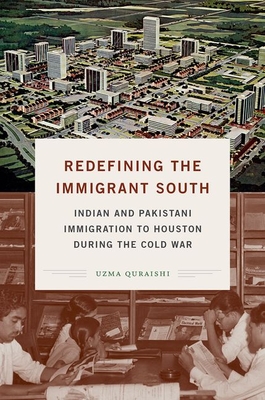
Redefining the Immigrant South : Indian and Pakistani Immigration to Houston During the Cold War
Book Details
Format
Hardback
Book Series
New Directions in Southern Studies
ISBN-10
1469655187
ISBN-13
9781469655185
Publisher
The University of North Carolina Press
Imprint
The University of North Carolina Press
Country of Manufacture
US
Country of Publication
GB
Publication Date
May 18th, 2020
Print length
336 Pages
Weight
333 grams
Dimensions
23.30 x 15.50 x 2.20 cms
KSh 15,100.00
Currently unavailable
0 in stock
Delivery Location
Delivery fee: Select location
Secure
Quality
Fast
By the late twentieth century, Houston's South Asian community had become one of the most prosperous in the metropolitan area and one of the largest in the country. Mining archives and using new oral histories, Uzma Quraishi traces this pioneering community from its midcentury roots to the early twenty-first century.
In the early years of the Cold War, the United States mounted expansive public diplomacy programs in the Global South, including initiatives with the recently partitioned states of India and Pakistan. U.S. operations in these two countries became the second- and fourth-largest in the world, creating migration links that resulted in the emergence of American universities, such as the University of Houston, as immigration hubs for the highly selective, student-led South Asian migration stream starting in the 1950s. By the late twentieth century, Houston's South Asian community had become one of the most prosperous in the metropolitan area and one of the largest in the country.
Mining archives and using new oral histories, Uzma Quraishi traces this pioneering community from its midcentury roots to the early twenty-first century, arguing that South Asian immigrants appealed to class conformity and endorsed the model minority myth to navigate the complexities of a shifting Sunbelt South. By examining Indian and Pakistani immigration to a major city transitioning out of Jim Crow, Quraishi reframes our understanding of twentieth-century migration, the changing character of the South, and the tangled politics of race, class, and ethnicity in the United States.
Mining archives and using new oral histories, Uzma Quraishi traces this pioneering community from its midcentury roots to the early twenty-first century, arguing that South Asian immigrants appealed to class conformity and endorsed the model minority myth to navigate the complexities of a shifting Sunbelt South. By examining Indian and Pakistani immigration to a major city transitioning out of Jim Crow, Quraishi reframes our understanding of twentieth-century migration, the changing character of the South, and the tangled politics of race, class, and ethnicity in the United States.
Get Redefining the Immigrant South by Uzma Quraishi at the best price and quality guaranteed only at Werezi Africa's largest book ecommerce store. The book was published by The University of North Carolina Press and it has 336 pages.
Customers Who Bought This Also Bought

Crusade for Justice – The Autobiography of Ida B. Wells, Second Edition
KSh 4,050.00

Killers of the Flower Moon
KSh 2,000.00

Warmth of Other Suns
KSh 3,050.00

Frederick Douglass
KSh 3,350.00

107 Days
KSh 4,500.00

Second Treatise of Government – Norton Library
KSh 1,600.00

Tuesdays With Morrie
KSh 2,000.00
My Bondage and My Freedom
KSh 1,600.00

Hidden Figures
KSh 2,000.00

America, América
KSh 3,650.00

Holding the Line
KSh 2,000.00

Nuclear Folly
KSh 3,050.00