
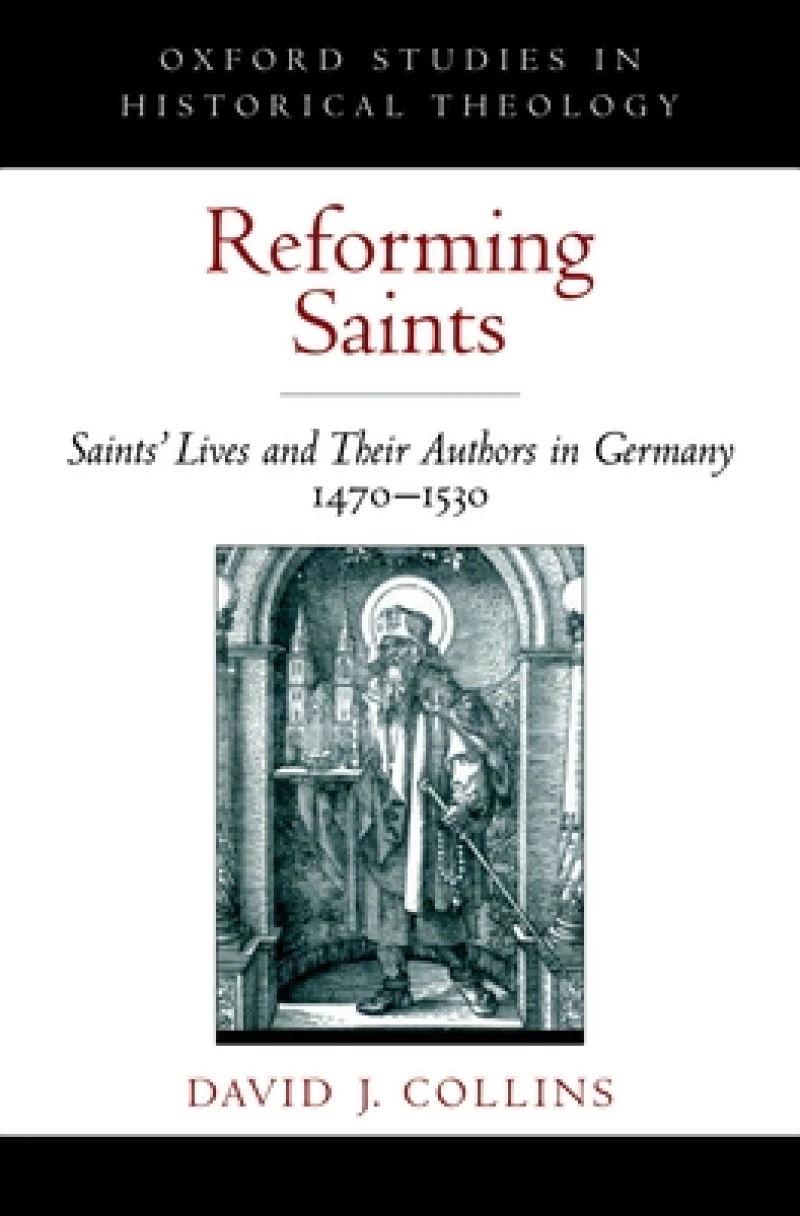
Reforming Saints : Saints' Lives and Their Authors in Germany, 1470-1530
Book Details
Format
Hardback or Cased Book
Book Series
Oxford Studies in Historical Theology
ISBN-10
0195329538
ISBN-13
9780195329537
Publisher
Oxford University Press Inc
Imprint
Oxford University Press Inc
Country of Manufacture
US
Country of Publication
GB
Publication Date
Feb 21st, 2008
Print length
246 Pages
Weight
542 grams
Dimensions
15.60 x 23.50 x 1.90 cms
Product Classification:
European historyEarly modern history: c 1450/1500 to c 1700Church historyChristian theology
Ksh 16,450.00
Manufactured on Demand
0 in stock
Delivery Location
Delivery fee: Select location
Secure
Quality
Fast
Reforming Saints is an investigation of how and why early German humanists were attracted to composing saint''s lives in the half century preceding the Reformation. David J. Collins approaches the humanists'' writings on their own terms and recaptures the creative energy the humanists brought to the task of revising the legends of the saints. The cult of the saints and Renaissance humanism are two topics that attract considerable scholarly attention. Reforming Saints considers them as studies rarely do - at their intersection.
In Reforming Saints, David J. Collins explains how and why Renaissance humanists composed Latin hagiography in Germany in the decades leading up to the Reformation. Contrary to the traditional wisdom, Collins''s research uncovers a resurgence in the composition of saints'' lives in the half century leading up to 1520. German humanists, he finds, were among the most active authors and editors of these texts. Focusing on forty Latin depictions of German saints written between 1470 and 1520, Collins finds patterns both in how these humanists chose their subjects and how they presented their holiness. He argues that the humanist hagiographers took up the writing of saints'' lives to investigate Germany''s medieval past, to reconstruct and exalt its greatness, and to advocate programs of religious and cultural reform. This literature, says Collins, left a legacy that polemicists and philologists in Catholic Europe would be using for their own purposes by the end of the sixteenth century. These hagiographic writings are thus both reflective and formative of the religious and cultural conflicts that defined this period of European history. To bolster his case, Collins draws not only on the Latin saints'' lives, but also on vernacular lives, maps and chorographic documents, personal and professional letters, papal, urban, and municipal archives, painting, sculpture and broadside print, and medieval and early modern histories and chronicles. The result is a fresh, new portrait of the humanism of Renaissance Germany. With his surprising and insightful conclusions, Collins sheds new light on humanism''s appropriation in Germany, particularly in its religious aspect. He approaches the humanists'' writings on their own terms and recaptures the creative energy the humanists brought to the task of revising the legends of the saints. His scholarly perspective includes the roles of emperors, princes, abbots, city councilmen, artists, librarians, soldiers, peasants, and pilgrims, showing how humanists reached larger and less learned audiences than many other kinds of writing ever could. The cult of the saints and Renaissance humanism are two topics that have attracted considerable scholarly attention. Reforming Saints considers them as seldom before - at their intersection.
Get Reforming Saints by at the best price and quality guaranteed only at Werezi Africa's largest book ecommerce store. The book was published by Oxford University Press Inc and it has pages.

