
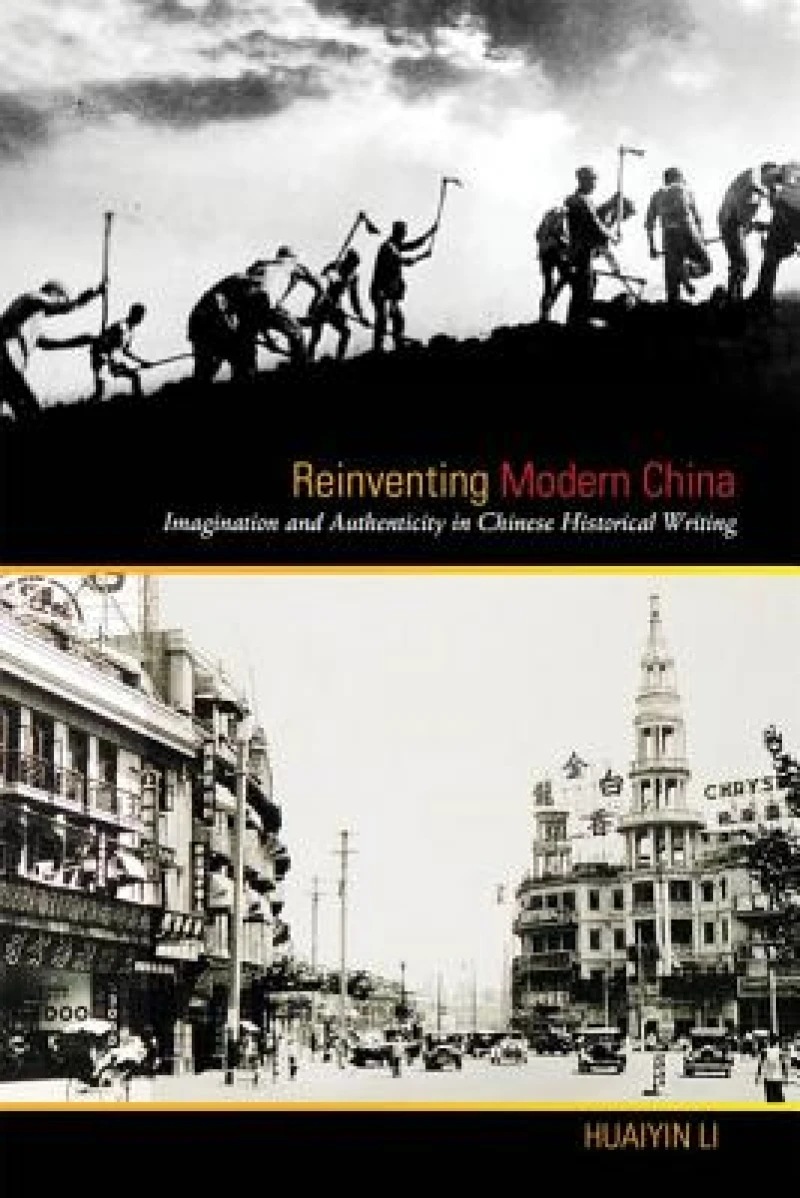
Reinventing Modern China : Imagination and Authenticity in Chinese Historical Writing
by
Huaiyin Li
Book Details
Format
Hardback or Cased Book
ISBN-10
0824836081
ISBN-13
9780824836085
Publisher
University of Hawai'i Press
Imprint
University of Hawai'i Press
Country of Manufacture
US
Country of Publication
GB
Publication Date
Oct 31st, 2012
Print length
344 Pages
Weight
712 grams
Dimensions
23.50 x 16.40 x 2.50 cms
Product Classification:
Asian historyAsian history
Ksh 7,600.00
Werezi Extended Catalogue
0 in stock
Delivery Location
Delivery fee: Select location
Secure
Quality
Fast
Offers the first systematic analysis of writings on modern Chinese history by historians in China from the early twentieth century to the present. It traces the construction of major interpretive schemes, the evolution of dominant historical narratives, and the unfolding of debates on the most controversial issues in different periods.
This work offers the first systematic analysis of writings on modern Chinese history by historians in China from the early twentieth century to the present. It traces the construction of major interpretive schemes, the evolution of dominant historical narratives, and the unfolding of debates on the most controversial issues in different periods. Placing history-writing in the context of political rivalry and ideological contestation, Huaiyin Li explicates how the historians’ dedication to faithfully reconstructing the past was compromised by their commitment to an imagined trajectory of history that fit their present-day agenda and served their needs of political legitimation.
Beginning with an examination of the contrasting narratives of revolution and modernisation in the Republican period, the book scrutinises changes in the revolutionary historiography after 1949, including its disciplinisation in the 1950s and early 1960s and radicalisation in the rest of the Mao era. It further investigates the rise of the modernisation paradigm in the reform era, the crises of master narratives since the late 1990s, and the latest development of the field. Central to the author’s analysis is the issue of truth and falsehood in historical representation. Li contends that both the revolutionary and modernisation historiographies before 1949 reflected historians’ lived experiences and contained a degree of authenticity in mirroring the historical processes of their own times. In sharp contrast, both the revolutionary historiography of the Maoist era and the modernisation historiography of the reform era were primarily products of historians’ ideological commitment, which distorted and concealed the past no less than revealed it.
In search of a more effective approach to rewriting modern Chinese history, Reinventing Modern China proposes a within-time, open-ended perspective, which allows for different directions in interpreting the events in modern China and views modern Chinese history as an unfinished process remaining to be defined as the country entered the twenty-first century.
Beginning with an examination of the contrasting narratives of revolution and modernisation in the Republican period, the book scrutinises changes in the revolutionary historiography after 1949, including its disciplinisation in the 1950s and early 1960s and radicalisation in the rest of the Mao era. It further investigates the rise of the modernisation paradigm in the reform era, the crises of master narratives since the late 1990s, and the latest development of the field. Central to the author’s analysis is the issue of truth and falsehood in historical representation. Li contends that both the revolutionary and modernisation historiographies before 1949 reflected historians’ lived experiences and contained a degree of authenticity in mirroring the historical processes of their own times. In sharp contrast, both the revolutionary historiography of the Maoist era and the modernisation historiography of the reform era were primarily products of historians’ ideological commitment, which distorted and concealed the past no less than revealed it.
In search of a more effective approach to rewriting modern Chinese history, Reinventing Modern China proposes a within-time, open-ended perspective, which allows for different directions in interpreting the events in modern China and views modern Chinese history as an unfinished process remaining to be defined as the country entered the twenty-first century.
Get Reinventing Modern China by at the best price and quality guaranteed only at Werezi Africa's largest book ecommerce store. The book was published by University of Hawai'i Press and it has pages.

