
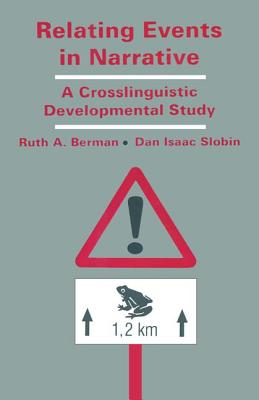
Relating Events in Narrative : A Crosslinguistic Developmental Study
Book Details
Format
Paperback / softback
ISBN-10
1138984914
ISBN-13
9781138984912
Publisher
Taylor & Francis Ltd
Imprint
Psychology Press Ltd
Country of Manufacture
GB
Country of Publication
GB
Publication Date
Feb 29th, 2016
Print length
764 Pages
Weight
1,096 grams
Dimensions
15.50 x 23.00 x 5.30 cms
KSh 10,750.00
Currently unavailable
0 in stock
Delivery Location
Delivery fee: Select location
Secure
Quality
Fast
This volume represents the culmination of an extensive research project that studied the development of linguistic form/function relations in narrative discourse. It is unique in the extent of data which it analyzes--more than 250 texts from children and adults speaking five different languages--and in its crosslinguistic, typological focus. It is the first book to address the issue of how the structural properties and rhetorical preferences of different native languages--English, German, Spanish, Hebrew, and Turkish--impinge on narrative abilities across different phases of development.
The work of Berman and Slobin and their colleagues provides insight into the interplay between shared, possibly universal, patterns in the developing ability to create well-constructed, globally organized narratives among preschoolers from three years of age compared with school children and adults, contrasted against the impact of typological and rhetorical features of particular native languages on how speakers express these abilities in the process of "relating events in narrative."
This volume also makes a special contribution to the field of language acquisition and development by providing detailed analyses of how linguistic forms come to be used in the service of narrative functions, such as the expression of temporal relations of simultaneity and retrospection, perspective-taking on events, and textual connectivity. To present this information, the authors prepared in-depth analyses of a wide range of linguistic systems, including tense-aspect marking, passive and middle voice, locative and directional predications, connectivity markers, null subjects, and relative clause constructions. In contrast to most work in the field of language acquisition, this book focuses on developments in the use of these early forms in extended discourse--beyond the initial phase of early language development.
The book offers a pioneering approach to the interactions between form and function in the development and use of language, from a typological linguistic perspective. The study is based on a large crosslinguistic corpus of narratives, elicited from preschool, school-age, and adult subjects. All of the narratives were elicited by the same picture storybook,Frog, Where Are You?, by Mercer Mayer. (An appendix lists related studies using the same storybook in 50 languages.) The findings illuminate both universal and language-specific patterns of development, providing new insights into questions of language and thought.
The work of Berman and Slobin and their colleagues provides insight into the interplay between shared, possibly universal, patterns in the developing ability to create well-constructed, globally organized narratives among preschoolers from three years of age compared with school children and adults, contrasted against the impact of typological and rhetorical features of particular native languages on how speakers express these abilities in the process of "relating events in narrative."
This volume also makes a special contribution to the field of language acquisition and development by providing detailed analyses of how linguistic forms come to be used in the service of narrative functions, such as the expression of temporal relations of simultaneity and retrospection, perspective-taking on events, and textual connectivity. To present this information, the authors prepared in-depth analyses of a wide range of linguistic systems, including tense-aspect marking, passive and middle voice, locative and directional predications, connectivity markers, null subjects, and relative clause constructions. In contrast to most work in the field of language acquisition, this book focuses on developments in the use of these early forms in extended discourse--beyond the initial phase of early language development.
The book offers a pioneering approach to the interactions between form and function in the development and use of language, from a typological linguistic perspective. The study is based on a large crosslinguistic corpus of narratives, elicited from preschool, school-age, and adult subjects. All of the narratives were elicited by the same picture storybook,Frog, Where Are You?, by Mercer Mayer. (An appendix lists related studies using the same storybook in 50 languages.) The findings illuminate both universal and language-specific patterns of development, providing new insights into questions of language and thought.
Get Relating Events in Narrative by Dan Isaac Slobin at the best price and quality guaranteed only at Werezi Africa's largest book ecommerce store. The book was published by Taylor & Francis Ltd and it has 764 pages.
Customers Who Bought This Also Bought

The Perks of Being a Bookworm
KSh 4,500.00
Semiotics and the Philosophy of Language
KSh 3,400.00
Chinese Children''s Reading Acquisition
KSh 16,200.00
New Trends in Language Acquisition Within the Generative Perspective
KSh 21,600.00
Vocabulary Studies in First and Second Language Acquisition
KSh 18,000.00

Improving the Emotional Intelligence of Translators
KSh 10,800.00
Phonology and Language Use
KSh 18,900.00

Engaging Children in Applied Linguistics Research
KSh 17,100.00

Optimality Theory and Pragmatics
KSh 8,100.00

Meaning
KSh 1,800.00

Nonverbal Steps to the Origins of Language
KSh 7,900.00
Active Learning from Infancy to Childhood
KSh 21,600.00
More in This Genre
The Perks of Being a Bookworm
KSh 4,500.00
Semiotics and the Philosophy of Language
KSh 3,400.00
Chinese Children''s Reading Acquisition
KSh 16,200.00
New Trends in Language Acquisition Within the Generative Perspective
KSh 21,600.00
Vocabulary Studies in First and Second Language Acquisition
KSh 18,000.00
Improving the Emotional Intelligence of Translators
KSh 10,800.00
