
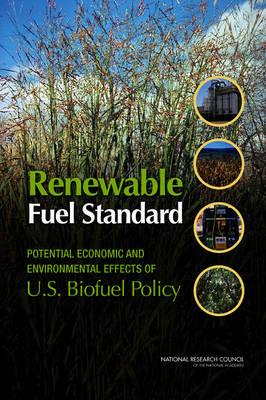
Renewable Fuel Standard : Potential Economic and Environmental Effects of U.S. Biofuel Policy
Book Details
Delivery Location
Delivery fee: Select location
In the United States, we have come to depend on plentiful and inexpensive energy to support our economy and lifestyles. In recent years, many questions have been raised regarding the sustainability of our current pattern of high consumption of nonrenewable energy and its environmental consequences. Further, because the United States imports about 55 percent of the nation''s consumption of crude oil, there are additional concerns about the security of supply. Hence, efforts are being made to find alternatives to our current pathway, including greater energy efficiency and use of energy sources that could lower greenhouse gas (GHG) emissions such as nuclear and renewable sources, including solar, wind, geothermal, and biofuels. The United States has a long history with biofuels and the nation is on a course charted to achieve a substantial increase in biofuels.
Renewable Fuel Standard evaluates the economic and environmental consequences of increasing biofuels production as a result of Renewable Fuels Standard, as amended by EISA (RFS2). The report describes biofuels produced in 2010 and those projected to be produced and consumed by 2022, reviews model projections and other estimates of the relative impact on the prices of land, and discusses the potential environmental harm and benefits of biofuels production and the barriers to achieving the RFS2 consumption mandate.
Policy makers, investors, leaders in the transportation sector, and others with concerns for the environment, economy, and energy security can rely on the recommendations provided in this report.
Get Renewable Fuel Standard by Board on Agriculture and Natural Resources, Board on Energy and Environmental Systems at the best price and quality guaranteed only at Werezi Africa's largest book ecommerce store. The book was published by National Academies Press and it has 416 pages.
Customers Who Bought This Also Bought

Boy Who Harnessed Wind
KSh 1,800.00

Underland
KSh 2,350.00

Smart Sustainability
KSh 9,350.00

Artificial Intelligence and Sustainable Management
KSh 22,500.00

Smart Sustainability
KSh 30,950.00

Digitalization of Mechanical Systems
KSh 33,850.00

Artificial Intelligence and Sustainable Management
KSh 9,900.00

Aqueous Batteries for Energy Storage
KSh 35,800.00

Transition Towards a Carbon Free Future
KSh 23,400.00

Renewable-Focused Operation and Control of Contemporary Power Systems
KSh 17,100.00

Climate Change and Climate Geoengineering
KSh 26,300.00

Green Transition and AI
KSh 10,200.00
More by Board on Agriculture and Natural Resources, Board on Energy and Environmental Systems
Living on an Active Earth
KSh 14,600.00

Calculating the Secrets of Life
KSh 24,650.00

Eager to Learn
KSh 9,550.00

Enhancing Professional Development for Teachers
KSh 7,400.00

Aviation Safety and Pilot Control
KSh 19,600.00
Vision and Voyages for Planetary Science in the Decade 2013-2022
KSh 7,550.00
Discipline-Based Education Research
KSh 6,650.00
Zero-Sustainment Aircraft for the U.S. Air Force
KSh 4,300.00

The Unique U.S.-Russian Relationship in Biological Science and Biotechnology
KSh 7,400.00

Technology Pathways
KSh 7,400.00

Implementing the New Biology
KSh 7,400.00

Sharing Research Data
KSh 29,350.00
