
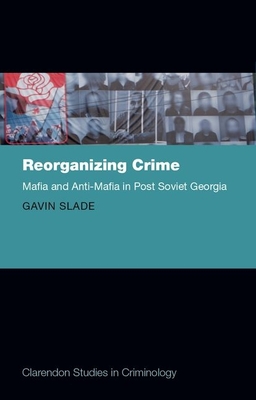
Reorganizing Crime : Mafia and Anti-Mafia in Post-Soviet Georgia
Book Details
Format
Hardback
Book Series
Clarendon Studies in Criminology
ISBN-10
0199674647
ISBN-13
9780199674640
Publisher
Oxford University Press
Imprint
Oxford University Press
Country of Manufacture
GB
Country of Publication
GB
Publication Date
Dec 5th, 2013
Print length
234 Pages
Weight
424 grams
Dimensions
22.40 x 16.30 x 1.90 cms
KSh 14,800.00
Currently unavailable
0 in stock
Delivery Location
Delivery fee: Select location
Secure
Quality
Fast
Through an innovative and engaging analysis of an often misunderstood cohort of organised crime in Georgia, this book explores the resilience of so-called dark networks, such as organized crime groups and terrorist cells, and tests the theories of how and why success in challenging such organizations can occur.
Arising from Soviet prison camps in the 1930s, career criminals known as ''thieves-in-law'' exist in one form or another throughout post-Soviet countries and have evolved into major transnational organized criminal networks since the dissolution of the USSR. Intriguingly, this criminal fraternity established a particular stronghold in the republic of Georgia where, by the 1990s, they had formed a mafia network of criminal associations that attempted to monopolize protection in both legal and illegal sectors of the economy. This saturation was to such an extent that thieves-in-law appeared to offer an alternative, and just as powerful, system of governance to the state.Following peaceful regime change with 2003''s Rose Revolution, Georgia prioritised reform of the criminal justice system generally, and an attack on the thieves-in-law specifically, using anti-organized crime policies that emulated approaches in Italy and America. Criminalization of association with thieves-in-law, radical reforms of the police and prisons, educational change, and controversial, draconian and extra-legal measures, amounted to arguably the most sustained anti-mafia policy implemented in any post-Soviet country - a policy the government believed would pull Georgia out of the Soviet past, declaring it a resounding success.Utilising unique access to primary sources of data, including police files, court cases, archives and expert interviews, Reorganizing Crime: Mafia and Anti-Mafia in Post-Soviet Georgia charts both the longevity and decline of the thieves-in-law, exploring the changes in the levels of resilience of members carrying this elite criminal status, and how this resilience has faded since 2005. Through an innovative and engaging analysis of this often misunderstood cohort of organized crime, this book engages with contemporary debates on the resilience of so-called dark networks, such as organized crime groups and terrorist cells, and tests theories of how and why success in challenging such organizations can occur.
Get Reorganizing Crime by Dr Gavin Slade at the best price and quality guaranteed only at Werezi Africa's largest book ecommerce store. The book was published by Oxford University Press and it has 234 pages.
Customers Who Bought This Also Bought

The Dryslwyn Castle Killings
KSh 1,900.00

The Psychopath Whisperer
KSh 1,800.00
Detain and Deport
KSh 22,600.00

Crime Scripting
KSh 7,900.00

Crime Scripting
KSh 30,950.00
The Explanation of Crime
KSh 17,800.00
Fundamentals of Criminological and Criminal Justice Inquiry
KSh 8,150.00
Sexual Violence
KSh 27,000.00

Security Relationship Management and The Shortest Hour Two-Book Bundle
KSh 18,550.00

Critical Infrastructure Protection, Risk Management, and Resilience
KSh 12,600.00

Organised Crime Groups involved in Fraud
KSh 7,900.00

Understanding and Preventing Corruption
KSh 9,900.00
