
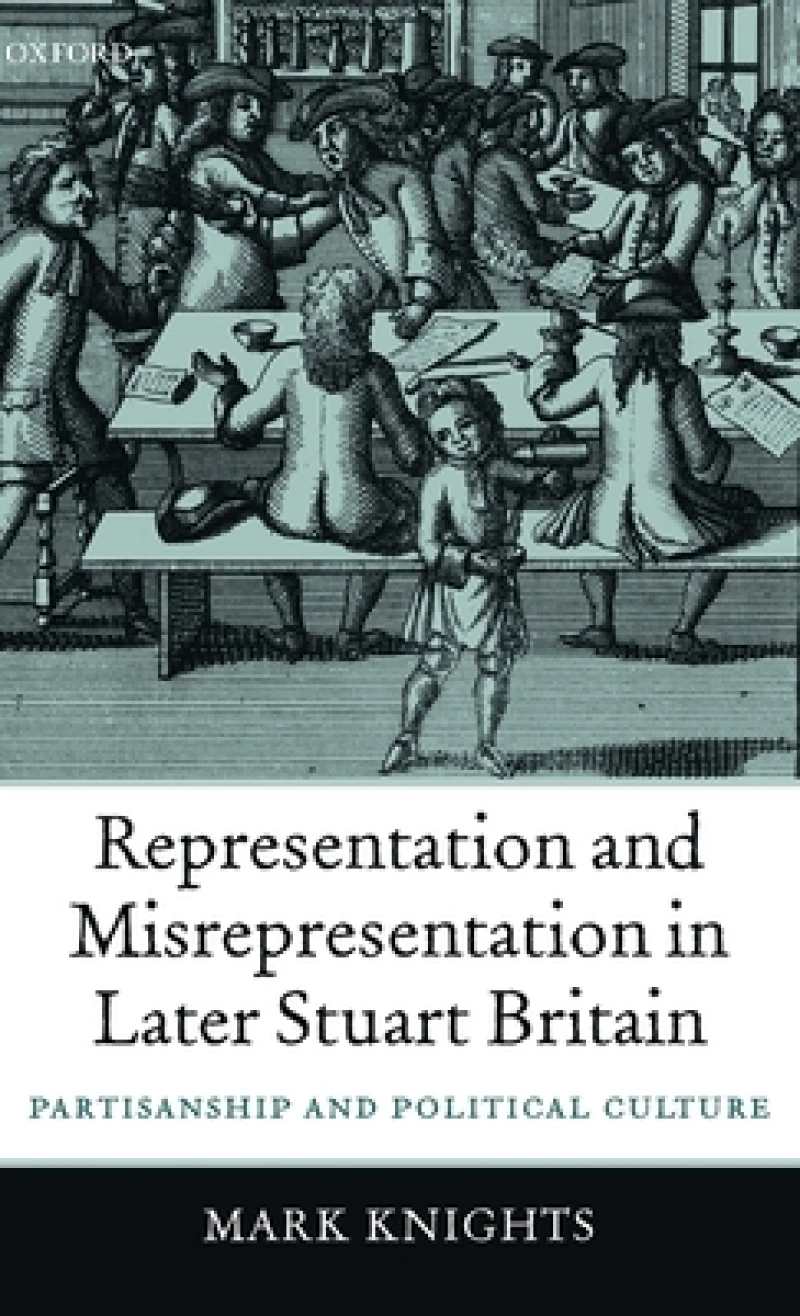
Representation and Misrepresentation in Later Stuart Britain : Partisanship and Political Culture
by
Mark Knights
Book Details
Format
Hardback or Cased Book
ISBN-10
0199258333
ISBN-13
9780199258338
Publisher
Oxford University Press
Imprint
Oxford University Press
Country of Manufacture
GB
Country of Publication
GB
Publication Date
Mar 24th, 2005
Print length
448 Pages
Weight
672 grams
Dimensions
22.30 x 14.60 x 3.00 cms
Ksh 44,650.00
Manufactured on Demand
0 in stock
Delivery Location
Delivery fee: Select location
Secure
Quality
Fast
Traces the development of the public as an arbiter of politics, the growth of a national political culture, the shift towards a representative society, a crisis of public discourse and credibility, and a political enlightenment rooted in local and national partisan conflict.
In this original and illuminating study, Mark Knights reveals how the political culture of the eighteenth century grew out of earlier trends and innovations. Arguing that the period 1675-1720 needs to be seen as the second stage of a seventeenth-century revolution that ran on until c.1720, the book traces the development of the public as an arbiter of politics, the growth of a national political culture, the shift towards a representative society, a crisis of public discourse and credibility, and a political enlightenment rooted in local and national partisan conflict. The ''public'' acquired a new status in the later Stuart period as a result of frequent elections, the lapse of pre-publication licensing, the emergence of party politics, the creation of a public debt and ideological conflict over popular sovereignty. These factors enlarged the role of the public and required it to make frequent acts of judgement. Yet contemporaries from across the political spectrum feared that the public might be misled by the misrepresentations peddled by their rivals. Each side, and those ostensibly of no side, discerned a culture of passion, slander, libel, lies, hypocrisy, dissimulation, conspiracy, private languages and fictions. ''Truth'' appeared an ambiguous, political matter. But the reaction to partisanship was also creative, for it helped to construct an ideal form of political discourse. This was one based on reason rather than passion, on politeness rather than incivility, on moderation rather than partisan zeal, on critical reading rather than credulity; and the realisation of those ideals rested on infrequent rather than frequent elections. Finding synergies between social, political, religious, scientific, literary, cultural and intellectual history, ''Representation and Misrepresentation'' reinvigorates the debate about the emergence of ''the public sphere'' in the later Stuart period.
Get Representation and Misrepresentation in Later Stuart Britain by at the best price and quality guaranteed only at Werezi Africa's largest book ecommerce store. The book was published by Oxford University Press and it has pages.

