
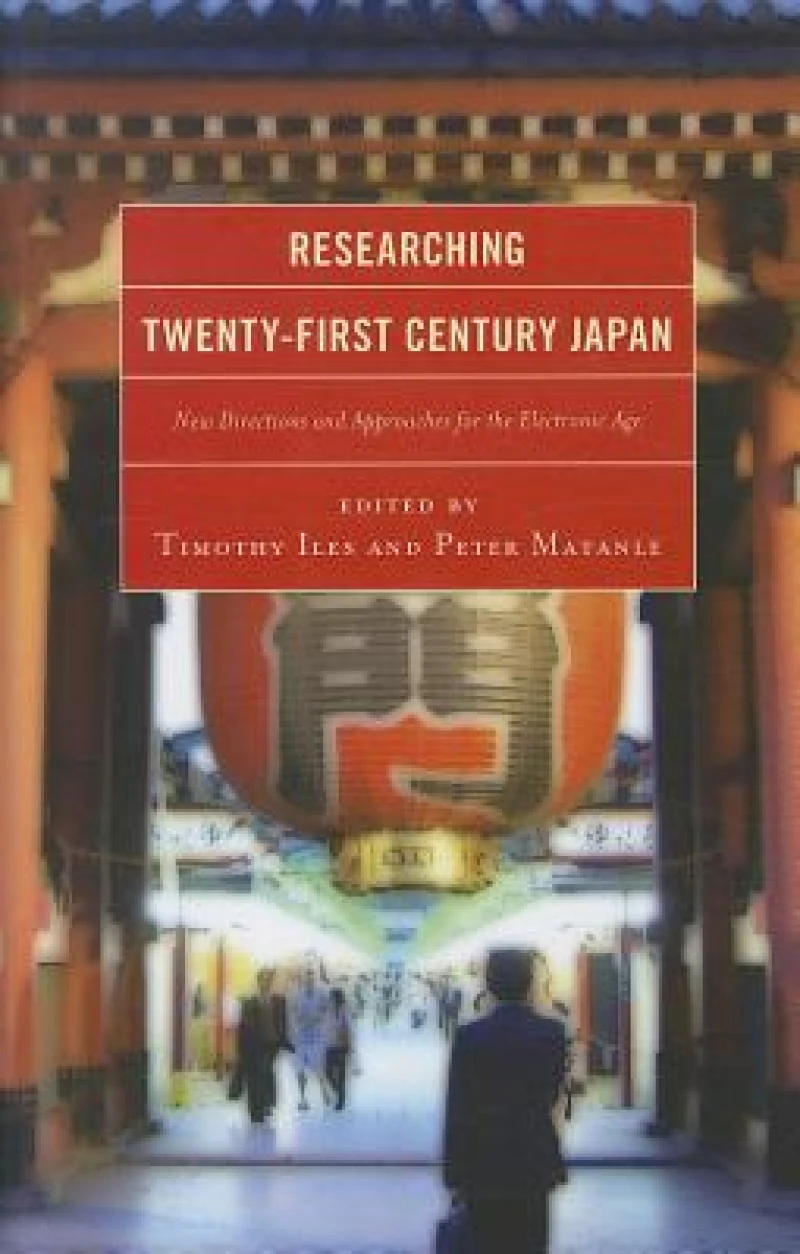
Researching Twenty-First Century Japan : New Directions and Approaches for the Electronic Age
Book Details
Format
Hardback or Cased Book
ISBN-10
0739170147
ISBN-13
9780739170144
Publisher
Bloomsbury Publishing Plc
Imprint
Lexington Books
Country of Manufacture
GB
Country of Publication
GB
Publication Date
Jan 12th, 2012
Print length
394 Pages
Weight
794 grams
Dimensions
23.70 x 16.50 x 2.80 cms
Product Classification:
Asian history21st century history: from c 2000 -Sociology
Ksh 25,350.00
Manufactured on Demand
0 in stock
Delivery Location
Delivery fee: Select location
Secure
Quality
Fast
The aim of this project is to bring together fifteen extensively revised, peer-reviewed articles by international scholars covering a diverse range of fields—from cinema to economics to history to the social sciences—addressing issues in contemporary Japan. These fifteen are all contributors to the first ten years of the EJCJS—the Electronic Journal of Contemporary Japanese Studies. The principal strengths of this volume are its diversity of approaches and its fundamentally interdisciplinary nature: it allows researchers in different fields to contribute to an overall understanding of Japan from the 1950s to the present. This ‘understanding’ is indeed comprehensive: chapters range from economics to politics to theatre, literature, immigration issues, religion, and multiculturalism. The chapters are uniformly precise in their analyses, drawing on many different forms of research, from textual analysis, historical documentation, linguistic analysis, to participant interviews and media studies. The diverse range of subject matter holds together very well, in that the contributors operate within a set of similar central values: the primacy of practical research over theory; the centrality of Japan even in studies which situate that country internationally; clarity of expression over jargon; and the desire to include readers through rhetorical care rather than exclude through esoteric applications of over-specialised terminology or assumptions. The chapters, while academic and informed by current scholarship, are accessible to general readers with interest in contemporary Japan. In this, the volume distinguishes itself as a highly readable, pertinent compendium of scholarship on contemporary Japan. It does not aim to be ‘all things for all readers’ but rather demonstrates to its readership the ways in which diverse aspects of contemporary Japan interlock and influence each other. Thus, aspects of contemporary religion show the influence of current economic conditions, while questions of Japanese identity reflect immigration issues and aspects of multiculturalism, while emerging in contemporary Japanese forms of mobile communication and linguistic change. Japan emerges as a complex, interwoven whole in this volume, but a whole which, as the chapters demonstrate, is amenable to scholarship from both insider and ‘outsider’ alike. The international contributors all have equal merit and equal voice here, to give a true multidisciplinary portrait of this intricate, culturally, historically, and economically vital nation.
The aim of this project is to bring together fifteen extensively revised, peer-reviewed articles by international scholars covering a diverse range of fields—from cinema to economics to history to the social sciences—addressing issues in contemporary Japan. These fifteen are all contributors to the first ten years of the EJCJS—the Electronic Journal of Contemporary Japanese Studies. The principal strengths of this volume are its diversity of approaches and its fundamentally interdisciplinary nature: it allows researchers in different fields to contribute to an overall understanding of Japan from the 1950s to the present. This ‘understanding’ is indeed comprehensive: chapters range from economics to politics to theatre, literature, immigration issues, religion, and multiculturalism. The chapters are uniformly precise in their analyses, drawing on many different forms of research, from textual analysis, historical documentation, linguistic analysis, to participant interviews and media studies. The diverse range of subject matter holds together very well, in that the contributors operate within a set of similar central values: the primacy of practical research over theory; the centrality of Japan even in studies which situate that country internationally; clarity of expression over jargon; and the desire to include readers through rhetorical care rather than exclude through esoteric applications of over-specialised terminology or assumptions. The chapters, while academic and informed by current scholarship, are accessible to general readers with interest in contemporary Japan. In this, the volume distinguishes itself as a highly readable, pertinent compendium of scholarship on contemporary Japan. It does not aim to be ‘all things for all readers’ but rather demonstrates to its readership the ways in which diverse aspects of contemporary Japan interlock and influence each other. Thus, aspects of contemporary religion show the influence of current economic conditions, while questions of Japanese identity reflect immigration issues and aspects of multiculturalism, while emerging in contemporary Japanese forms of mobile communication and linguistic change. Japan emerges as a complex, interwoven whole in this volume, but a whole which, as the chapters demonstrate, is amenable to scholarship from both insider and ‘outsider’ alike. The international contributors all have equal merit and equal voice here, to give a true multidisciplinary portrait of this intricate, culturally, historically, and economically vital nation.
Get Researching Twenty-First Century Japan by at the best price and quality guaranteed only at Werezi Africa's largest book ecommerce store. The book was published by Bloomsbury Publishing Plc and it has pages.

