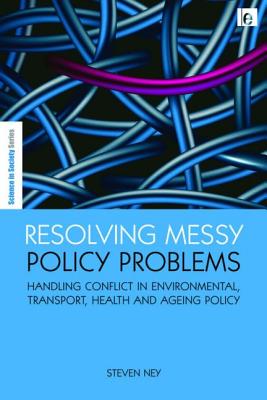
Resolving Messy Policy Problems : Handling Conflict in Environmental, Transport, Health and Ageing Policy
by
Steven Ney
Book Details
Format
Paperback / softback
Book Series
The Earthscan Science in Society Series
ISBN-10
0415850355
ISBN-13
9780415850353
Publisher
Taylor & Francis Ltd
Imprint
Routledge
Country of Manufacture
GB
Country of Publication
GB
Publication Date
Dec 12th, 2013
Print length
224 Pages
Weight
354 grams
Dimensions
15.60 x 23.20 x 1.30 cms
Product Classification:
Politics & governmentPolitics and governmentPublic international lawGeophysicsEarth sciences
KSh 10,100.00
Currently unavailable
0 in stock
Delivery Location
Delivery fee: Select location
Secure
Quality
Fast
First Published in 2009. Routledge is an imprint of Taylor & Francis, an informa company.
Our lives increasingly take place in ever more complex and interconnected networks that blur the boundaries we have traditionally used to define our social and political spaces. Accordingly, the policy problems that governments are called upon to deal with have become less clear-cut and far messier. This is particularly the case with climate change, environmental policy, transport, health and ageing - all areas in which the tried-and-tested linear policy solutions are increasingly inadequate or failing. What makes messy policy problems particularly uncomfortable for policy makers is that science and scientific knowledge have themselves become sources of uncertainty and ambiguity. Indeed what is to count as a ''rational solution'' is itself now the subject of considerable debate and controversy. This book focuses on the intractable conflict that characterises policy debate about messy issues. The author first develops a framework for analysing these conflicts and then applies the conceptual framework to four very different policy issues: the environment - focussing on climate change - as well as transport, ageing and health. Using evidence from Europe, North America and the Asia-Pacific, the book compares how policy actors construct contending narratives in order to make sense of, and deal with, messy challenges. In the final section the author discusses the implications of the analysis for collective learning and adaptation processes. The aim is to contribute to a more refined understanding of policy-making in the face of uncertainty and, most importantly, to provide practical methods for critical reflection on policy and to point to sustainable adaptation pathways and learning mechanisms for policy formulation.
Get Resolving Messy Policy Problems by Steven Ney at the best price and quality guaranteed only at Werezi Africa's largest book ecommerce store. The book was published by Taylor & Francis Ltd and it has 224 pages.
Customers Who Bought This Also Bought

Regime Change
KSh 5,050.00

Art of War / The Book of Lord Shang
KSh 1,100.00

Wretched of the Earth
KSh 2,000.00

White Saviorism In International Development
KSh 3,800.00
How To Do Nothing
KSh 2,700.00

How Civil Wars Start
KSh 2,000.00

Tomorrow Is Yesterday
KSh 4,700.00

The Thinking Machine
KSh 2,350.00

Second Treatise of Government – Norton Library
KSh 1,600.00

Becoming
KSh 2,350.00

A River in Darkness
KSh 1,250.00

Warning to the West
KSh 1,600.00