
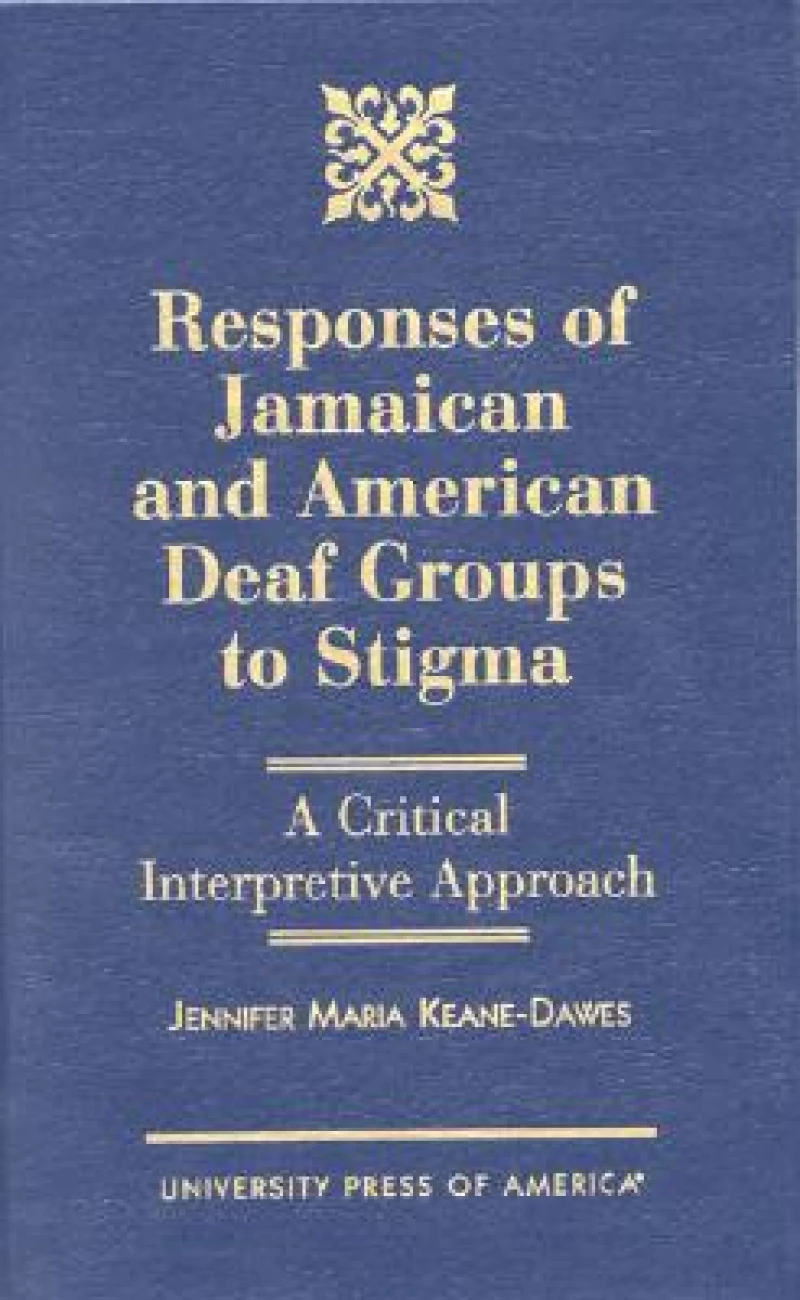
Responses of Jamaican and American Deaf Groups to Stigma : A Critical Interpretive Approach
Book Details
Format
Hardback or Cased Book
ISBN-10
0761806520
ISBN-13
9780761806523
Publisher
University Press of America
Imprint
University Press of America
Country of Manufacture
US
Country of Publication
GB
Publication Date
Aug 29th, 1997
Print length
146 Pages
Weight
349 grams
Dimensions
22.10 x 14.60 x 1.70 cms
Product Classification:
Society & culture: general
Ksh 8,450.00
Re-Printing
0 in stock
Delivery Location
Delivery fee: Select location
Secure
Quality
Fast
Responses of Jamaican and American Deaf Groups to Stigma asserts that Goffman's 1963 theory of stigma does not account for cultural variables which affect how deaf individuals deal with the perception that deafness is negatively different and that deaf individuals in selected cultures use different rules to contend with this perception. The people studied for this book were between eighteen and twenty-two years of age, and were from educational institutions in Jamaica and the United States. The book reveals several important points. First, that stigma is transactional. Deaf persons locate stigma in the sender, as they exert control over their communication interactions, they become agents in the transaction between themselves and hearing persons. Second, deaf persons who regard themselves as part of the deaf culture are proud of their cultural identity and do not defensively cower as Goffman suggests. And third, the metatheoretical assumptions of the interpretive paradigm guided the study to facilitate the emergence of another perspective on stigma from the voices of deaf persons themselves and not from a nomothetic covering law. The book also makes several suggestions to the Jamaican Government, African American and White American researchers who are deaf, as well as to the historically Black college, Howard University, to facilitate communication between the deaf and hearing cultures.
Responses of Jamaican and American Deaf Groups to Stigma asserts that Goffman''s 1963 theory of stigma does not account for cultural variables which affect how deaf individuals deal with the perception that deafness is negatively different and that deaf individuals in selected cultures use different rules to contend with this perception. The people studied for this book were between eighteen and twenty-two years of age, and were from educational institutions in Jamaica and the United States. The book reveals several important points. First, that stigma is transactional. Deaf persons locate stigma in the sender, as they exert control over their communication interactions, they become agents in the transaction between themselves and hearing persons. Second, deaf persons who regard themselves as part of the deaf culture are proud of their cultural identity and do not defensively cower as Goffman suggests. And third, the metatheoretical assumptions of the interpretive paradigm guided the study to facilitate the emergence of another perspective on stigma from the voices of deaf persons themselves and not from a nomothetic covering law. The book also makes several suggestions to the Jamaican Government, African American and White American researchers who are deaf, as well as to the historically Black college, Howard University, to facilitate communication between the deaf and hearing cultures.
Get Responses of Jamaican and American Deaf Groups to Stigma by at the best price and quality guaranteed only at Werezi Africa's largest book ecommerce store. The book was published by University Press of America and it has pages.

