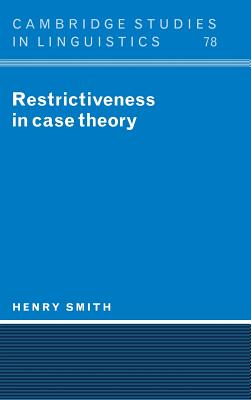
Restrictiveness in Case Theory
by
Henry Smith
Book Details
Format
Paperback / softback
Book Series
Cambridge Studies in Linguistics
ISBN-10
0521026555
ISBN-13
9780521026550
Publisher
Cambridge University Press
Imprint
Cambridge University Press
Country of Manufacture
GB
Country of Publication
GB
Publication Date
Jun 1st, 2006
Print length
344 Pages
Weight
525 grams
Dimensions
22.90 x 15.30 x 2.00 cms
Product Classification:
Grammar, syntax & morphologyGrammar, syntax and morphology
KSh 8,550.00
Currently unavailable
0 in stock
Delivery Location
Delivery fee: Select location
Secure
Quality
Fast
Henry Smith develops a theory of syntactic case and examines its synchronic and diachronic consequences. Within a unification-based framework, the book draws out pervasive patterns in the relationship between morphosyntax 'linking' and grammatical function, with an examination of a wide array of synchronic and diachronic data.
Henry Smith develops a theory of syntactic case and examines its synchronic and diachronic consequences. Within a unification-based framework, the book draws out pervasive patterns in the relationship between morphosyntax ('linking') and grammatical function. The theory proposed consists of three ordered constraints on the association of NPs and arguments, based on the central notion of 'restrictiveness'. Beginning with a detailed study of dative substitution in Icelandic, the author moves on to examine a wide array of synchronic and diachronic data and to construct a typology of case. Theoretically innovative and sophisticated, and descriptively wide-ranging, this book will appeal to all those interested in the cross-linguistic marking of case and the ways in which case systems may change over time.
Get Restrictiveness in Case Theory by Henry Smith at the best price and quality guaranteed only at Werezi Africa's largest book ecommerce store. The book was published by Cambridge University Press and it has 344 pages.
Customers Who Bought This Also Bought

Essential German Grammar
KSh 8,400.00
Analysing Sentences
KSh 7,400.00

Diachronic divergences in West Iberian languages
KSh 19,250.00

A Grammar of Teotitlan del Valle Zapotec
KSh 28,100.00

Argument Legitimacy Principles
KSh 30,950.00

A Semantic Grammar of Kiowa
KSh 20,450.00

Exploring Passivization
KSh 18,000.00

A Comparative Analysis of Classifier-Noun Structures in Chinese and English
KSh 32,000.00

Construction Grammar and Sociolinguistic Theory
KSh 20,450.00
Control as Movement
KSh 19,600.00
A Historical Syntax of English
KSh 19,800.00
Formulaic Language and the Lexicon
KSh 19,600.00