
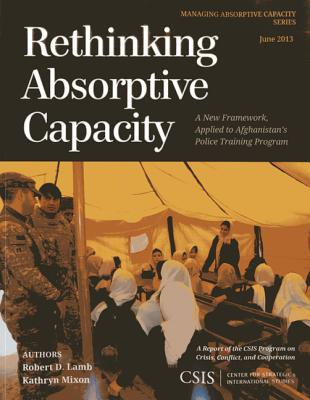
Rethinking Absorptive Capacity : A New Framework, Applied to Afghanistan's Police Training Program
Book Details
Format
Paperback / softback
Book Series
CSIS Reports
ISBN-10
144222505X
ISBN-13
9781442225053
Publisher
Centre for Strategic & International Studies,U.S.
Imprint
Centre for Strategic & International Studies,U.S.
Country of Manufacture
GB
Country of Publication
GB
Publication Date
Jul 1st, 2013
Print length
68 Pages
Weight
192 grams
Dimensions
28.00 x 21.50 x 1.00 cms
KSh 9,000.00
Currently unavailable
0 in stock
Delivery Location
Delivery fee: Select location
Secure
Quality
Fast
In development, stabilization, and peace building, donors increasingly recognize the importance of being sensitive to the local contexts of their efforts. Yet the use of “blueprints” remains widespread. Even when standard approaches are modified for particular aid partners, there often remains a poor fit between donor efforts and local conditions. The waste and disruptions that result are even greater in high-profile and politically sensitive situations, when political considerations demand large-scale responses.
Get Rethinking Absorptive Capacity by Kathryn Mixon, Robert D. Lamb at the best price and quality guaranteed only at Werezi Africa's largest book ecommerce store. The book was published by Centre for Strategic & International Studies,U.S. and it has 68 pages.
Customers Who Bought This Also Bought

Regime Change
KSh 5,050.00

Art of War / The Book of Lord Shang
KSh 1,100.00

Wretched of the Earth
KSh 2,000.00

White Saviorism In International Development
KSh 3,800.00

How To Do Nothing
KSh 2,700.00

How Civil Wars Start
KSh 2,000.00

Tomorrow Is Yesterday
KSh 4,700.00

The Thinking Machine
KSh 2,350.00

Second Treatise of Government – Norton Library
KSh 1,600.00

Becoming
KSh 2,350.00

A River in Darkness
KSh 1,250.00

Warning to the West
KSh 1,600.00
More by Kathryn Mixon, Robert D. Lamb
Colombia
KSh 9,000.00
Rethinking Legitimacy and Illegitimacy
KSh 9,000.00
South Asia Regional Dynamics and Strategic Concerns
KSh 7,550.00
Rethinking Civilian Stabilization and Reconstruction
KSh 9,000.00
Absorptive Capacity in the Security and Justice Sectors
KSh 9,000.00
U.S. Policy Responses to Potential Transitions
KSh 9,000.00
