
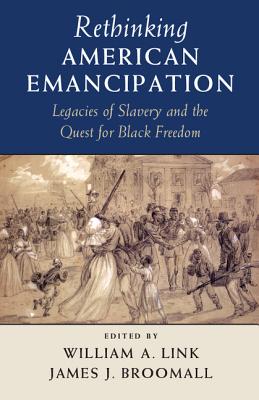
Rethinking American Emancipation : Legacies of Slavery and the Quest for Black Freedom
Book Details
Format
Hardback
Book Series
Cambridge Studies on the American South
ISBN-10
1107073030
ISBN-13
9781107073036
Publisher
Cambridge University Press
Imprint
Cambridge University Press
Country of Manufacture
GB
Country of Publication
GB
Publication Date
Nov 12th, 2015
Print length
292 Pages
Weight
520 grams
Dimensions
23.70 x 15.30 x 2.10 cms
KSh 15,500.00
Currently unavailable
0 in stock
Delivery Location
Delivery fee: Select location
Secure
Quality
Fast
The nine essays in this volume unpack the long history and varied meanings of the emancipation of American slaves. Together, the contributions argue that 1863 did not mark an end point or a mission accomplished in black freedom; rather, it initiated the beginning of an ongoing, contested process.
On January 1, 1863, Abraham Lincoln announced the Emancipation Proclamation, an event that soon became a bold statement of presidential power, a dramatic shift in the rationale for fighting the Civil War, and a promise of future freedom for four million enslaved Americans. But the document marked only a beginning; freedom's future was anything but certain. Thereafter, the significance of both the Proclamation and of emancipation assumed new and diverse meanings, as African Americans explored freedom and the nation attempted to rebuild itself. Despite the sweeping power of Lincoln's Proclamation, struggle, rather than freedom, defined emancipation's broader legacy. The nine essays in this volume unpack the long history and varied meanings of the emancipation of American slaves. Together, the contributions argue that 1863 did not mark an end point or a mission accomplished in black freedom; rather, it initiated the beginning of an ongoing, contested process.
Get Rethinking American Emancipation by James J. Broomall at the best price and quality guaranteed only at Werezi Africa's largest book ecommerce store. The book was published by Cambridge University Press and it has 292 pages.
Customers Who Bought This Also Bought

Crusade for Justice – The Autobiography of Ida B. Wells, Second Edition
KSh 4,050.00

Killers of the Flower Moon
KSh 2,000.00

Warmth of Other Suns
KSh 3,050.00

Frederick Douglass
KSh 3,350.00

107 Days
KSh 4,500.00

Second Treatise of Government – Norton Library
KSh 1,600.00

Tuesdays With Morrie
KSh 2,000.00
My Bondage and My Freedom
KSh 1,600.00

Hidden Figures
KSh 2,000.00

America, América
KSh 3,650.00

Holding the Line
KSh 2,000.00

Nuclear Folly
KSh 3,050.00
