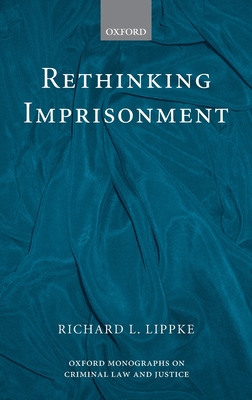
Rethinking Imprisonment
Book Details
Format
Hardback
Book Series
Oxford Monographs on Criminal Law and Justice
ISBN-10
019920912X
ISBN-13
9780199209125
Publisher
Oxford University Press
Imprint
Oxford University Press
Country of Manufacture
GB
Country of Publication
GB
Publication Date
Jan 25th, 2007
Print length
294 Pages
Weight
596 grams
Dimensions
16.60 x 24.20 x 2.30 cms
Product Classification:
Social theoryCrime & criminologyPolitics & governmentCriminal law & procedure
KSh 20,000.00
Currently unavailable
0 in stock
Delivery Location
Delivery fee: Select location
Secure
Quality
Fast
This book draws upon philosophical arguments, criminological evidence, and legal literature on prisoners' rights and sentencing to explore the restrictions and deprivations that can be legitimately imposed on serious offenders in the name of punishment.
Drawing on philosophical arguments, criminological evidence, and the legal literature on prisoners'' rights, Rethinking Imprisonment defends a normative theory of imprisonment. Such a theory provides an account of the justified conditions of prison confinement - the restrictions and deprivations that may be legitimately imposed on serious offenders in the name of punishment. The theory of legal punishment upon which this account builds combines retributive and crime reduction elements, with the former accorded priority on both moral and epistemic grounds. Contrary to its formidable reputation, retributivism is shown to place important and substantial limits on the character of imprisonment, its appropriate use, and duration. Much of the contemporary use of imprisonment as a legal sanction is arguably unjustified on all three counts.Rethinking Imprisonment urges the adoption of prison conditions at or near the ''minimum conditions of confinement'' which severely curtail the freedom of movement, freedom of association, and privacy of prisoners, yet are still consistent with ensuring the basic physical and psychological welfare of prisoners, and provide them with access to paid labor, visitation, entertainment, recreation, and retained civic and political rights. This book argues firstly that the punishment of serious offenders generally requires no more than the imposition of ''minimum conditions of confinement'' and secondly that moral constraints on punishment derived from retributivism in conjunction with the available evidence about the prison regimes most likely to reduce crime point towards more humane and less restrictive prisons.
Get Rethinking Imprisonment by Richard L. Lippke at the best price and quality guaranteed only at Werezi Africa's largest book ecommerce store. The book was published by Oxford University Press and it has 294 pages.
Customers Who Bought This Also Bought

Development as Freedom
KSh 2,900.00

Nexus
KSh 2,350.00

Being and Nothingness
KSh 7,300.00

The Sane Society
KSh 3,500.00

Sister Outsider
KSh 2,000.00
Revenge of the Tipping Point
KSh 3,050.00

Half of It
KSh 2,000.00

Feminist Criticism and Social Change
KSh 9,200.00

Homo Deus
KSh 2,350.00

Nexus
KSh 5,050.00

Half of It
KSh 3,600.00

Fanon and Education
KSh 5,250.00