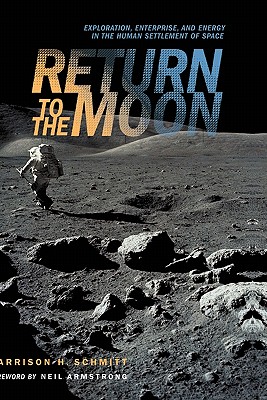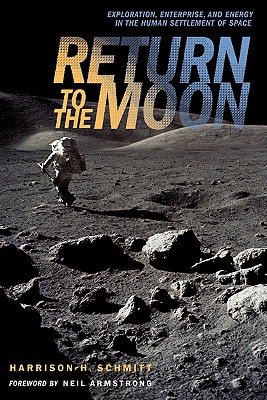
Return to the Moon : Exploration, Enterprise, and Energy in the Human Settlement of Space
Softcover reprint of hardcover 1st ed. 2006
Book Details
Format
Paperback / softback
ISBN-10
1441920250
ISBN-13
9781441920256
Edition
Softcover reprint of hardcover 1st ed. 2006
Publisher
Springer-Verlag New York Inc.
Imprint
Springer-Verlag New York Inc.
Country of Manufacture
US
Country of Publication
GB
Publication Date
Oct 18th, 2010
Print length
336 Pages
Weight
502 grams
Dimensions
23.50 x 16.20 x 1.90 cms
KSh 7,200.00
Currently unavailable
0 in stock
Delivery Location
Delivery fee: Select location
Secure
Quality
Fast
Former NASA Astronaut Harrison Schmitt advocates a private, investor-based approach to returning humans to the Moon—to extract Helium 3 for energy production, to use the Moon as a platform for science and manufacturing, and to establish permanent human colonies there in a kind of stepping stone community on the way to deeper space.
Introduction: 25 Years from Today.- The Legacy of Apollo: The geopolitical, cultural, and scientific legacy of Apollo, including the discovery of lunar energy resources.- Global Energy in the 21st Century: The increasing future demand for energy and the alternatives to meet that demand including lunar Helium-3 fusion.- Fundamentals of Helium-3 Fusion: The basic principles of Helium-3 fusion including its advantages and disadvantages relative to other energy alternatives.- Lunar Helium-3 Resources: How much we know about the concentration, distribution, and geology of lunar Helium-3 and related resources.- Economic Approaches to a Return to the Moon: Comparison of various combinations of private, federal, and international approaches to funding and managing a return to the Moon.- Lessons from Apollo Management: The nature of the Apollo management system and the lessons that can be drawn from its successes and failures.- Private Business/Investor Approach: The details and milestones in a private business and investor-based approach to a return to the Moon.- Bridging Businesses: Bridging businesses that apply helium-3 fusion technologies; in particular, positron emitting isotope production for medical diagnostics (PET), and a general discussion of other, follow-on bridging businesses.- Lunar Resource Production Operations: The essential elements of the initiation and early operation of a lunar resource production and processing endeavor.- Ancillary Businesses: The use of technologies developed for accessing and using lunar Helium-3 for space exploration, astronomy from the Moon, space tourism, diversion of asteroids and comets, and national security.- Space Law Related to Lunar Resources: Lunar resource development in the context of international law and specifically of the Outer Space Treaty of 1967.- Human vs Machine Roles in Space Exploration and Development: The relative merits of human and robotic systems in space.- Long-term Implications: The long-term implications of the development of lunar resources on the betterment of the human condition, the advancement of civilization, the settlement of space, and the defense of the Earth.
Get Return to the Moon by Harrison Schmitt at the best price and quality guaranteed only at Werezi Africa's largest book ecommerce store. The book was published by Springer-Verlag New York Inc. and it has 336 pages.
Customers Who Bought This Also Bought

Order of Time
KSh 2,350.00

Anaximander
KSh 2,000.00

What Is Dark Matter?
KSh 3,600.00
Observations of Comets, from B. C. 611 to A. D. 640
KSh 2,550.00

Astrosemiosis
KSh 4,500.00

The Back Garden Astronomer
KSh 2,000.00
The Night Sky Companion
KSh 4,850.00

Periodic, Quasi-Periodic and Chaotic Motions in Celestial Mechanics
KSh 32,400.00

Tycho Brahe
KSh 8,200.00

Asteroids
KSh 11,150.00

Race-Class Relations and Integration in Secondary Education
KSh 8,100.00

Galileo
KSh 2,900.00