
Book Details
Format
Paperback / softback
ISBN-10
0199212473
ISBN-13
9780199212477
Edition
2 Revised edition
Publisher
Oxford University Press
Imprint
Oxford University Press
Country of Manufacture
GB
Country of Publication
GB
Publication Date
Jul 26th, 2007
Print length
384 Pages
Weight
496 grams
Dimensions
21.50 x 13.80 x 2.20 cms
Product Classification:
PhilosophyPhilosophy of religionTheology
KSh 9,500.00
Currently unavailable
0 in stock
Delivery Location
Delivery fee: Select location
Secure
Quality
Fast
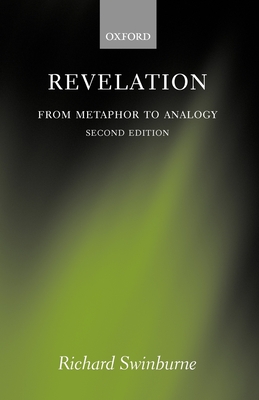
Christianity and other religions claim that their books and creeds contain truths revealed by God. How can we know whether they do? This book investigates the claim of the Christian religion to have such revealed truths, and so, considers which parts of the Bible are to be regarded as literal history, and which as metaphorical truth.
The great religions often claim that their books or creeds contain truths revealed by God. How could we know that they do? In the second edition of Revelation, renowned philosopher of religion Richard Swinburne addresses this central question. But since the books of great religions often contain much poetry and parable, Swinburne begins by investigating how eternal truth can be conveyed in unfamiliar genres, by analogy and metaphor, within false presuppositions about science and history. In the final part of the book, Swinburne then applies the results of Parts I and II to assessing the evidence that the teaching of the Christian Church constitutes a revelation from God. In the course of his philosophical exploration, Swinburne considers how the church which Jesus founded is to be identified today and presents a sustained discussion of which passages in the Bible should be understood literally and which should be understood metaphorically. This is a fuller and entirely rewritten second edition of Revelation, the most notable new feature of which is a long chapter examining whether traditional Christian claims about personal morality (divorce, homosexuality, abortion, etc.) can be regarded as revealed truths. A formal appendix shows how the structure of evidence supporting the Christian revelation can be articulated in terms of the probability calculus (and shows that Plantinga''s well-known argument from ''dwindling probabilities'' against probabilistic arguments of this kind is not cogent).
Get Revelation by Richard Swinburne at the best price and quality guaranteed only at Werezi Africa's largest book ecommerce store. The book was published by Oxford University Press and it has 384 pages.
Customers Who Bought This Also Bought
Decolonizing Language and Other Revolutionary Ideas
KSh 2,350.00

How to Read a Book
KSh 2,000.00
Decolonizing Language and Other Revolutionary Ideas
KSh 3,600.00

Creative Act
KSh 3,250.00
Groundwork for the Metaphysics of Morals
KSh 2,000.00

Things in Nature Merely
KSh 2,000.00
Meditations – The Philosophy Classic
KSh 2,150.00

Great Ideas Social Contract
KSh 1,450.00
How to Be a Leader – An Ancient Guide to Wise Leadership
KSh 2,800.00
The Daily Laws
KSh 2,350.00

Three Critiques, 3-volume Set
KSh 14,000.00

Philosophical Dictionary
KSh 2,700.00
More by Richard Swinburne
Faith and Reason
KSh 9,850.00

Personal Identity
KSh 7,200.00
The Existence of God
KSh 8,500.00
The Coherence of Theism
KSh 6,850.00
The Christian God
KSh 10,000.00
Was Jesus God?
KSh 3,950.00
The Evolution of the Soul
KSh 11,500.00
Epistemic Justification
KSh 10,100.00

The Evolution of the Soul
KSh 37,150.00
Was Jesus God?
KSh 1,800.00
The Resurrection of God Incarnate
KSh 9,600.00
Is There a God?
KSh 2,450.00
