
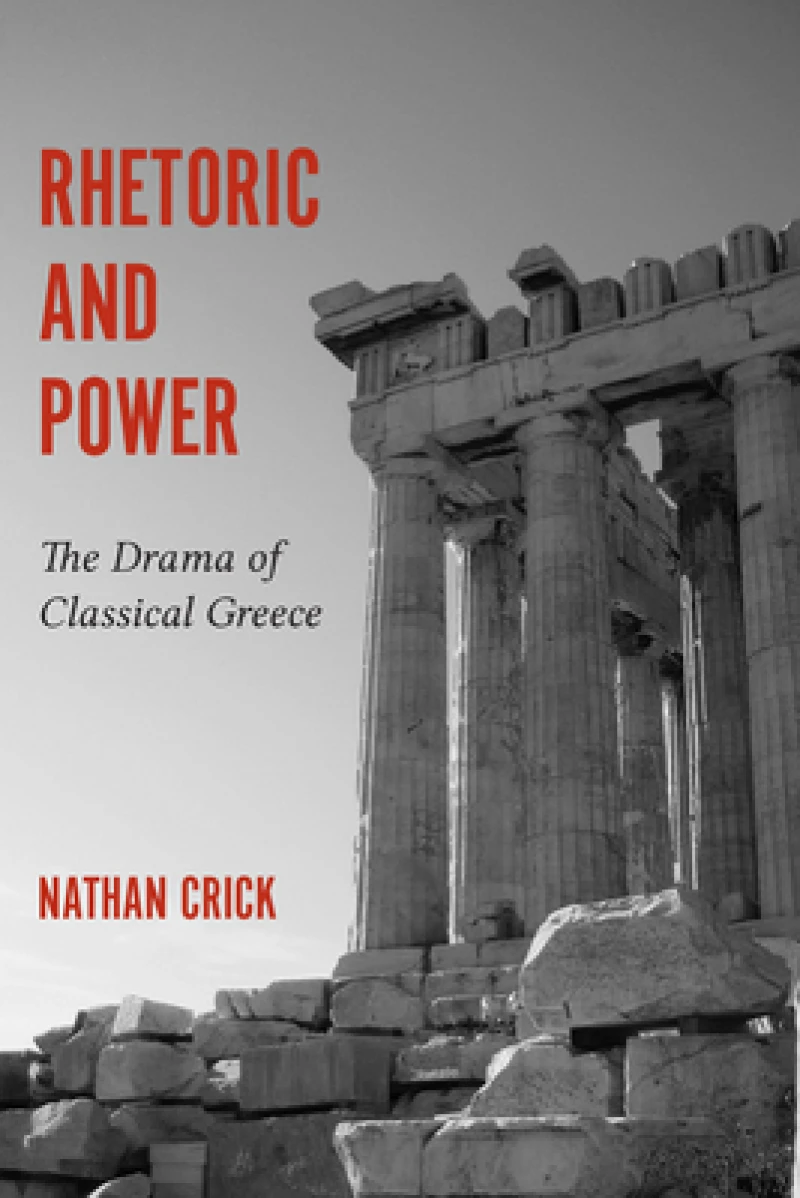
Rhetoric and Power : The Drama of Classical Greece
by
Nathan Crick
Book Details
Format
Paperback / Softback
Book Series
Studies in Rhetoric/Communication
ISBN-10
1611179815
ISBN-13
9781611179811
Publisher
University of South Carolina Press
Imprint
University of South Carolina Press
Country of Manufacture
US
Country of Publication
GB
Publication Date
Feb 23rd, 2018
Print length
272 Pages
Weight
392 grams
Dimensions
22.60 x 15.20 x 2.00 cms
Ksh 6,300.00
Werezi Extended Catalogue
0 in stock
Delivery Location
Delivery fee: Select location
Secure
Quality
Fast
Explores the history of rhetoric by explaining its origin and development in classical Greece, beginning with the oral displays of Homeric eloquence in a time of kings, following its ascent to power during the age of Pericles and the Sophists, and ending with its transformation into a rational discipline with Aristotle in a time of literacy and empire.
An examination of how intellectuals and artists conceptualized rhetoric as a medium of power in a dynamic age of democracy and empire
In Rhetoric and Power, Nathan Crick dramatizes the history of rhetoric by explaining its origin and development in classical Greece, beginning with the oral displays of Homeric eloquence in a time of kings, following its ascent to power during the age of Pericles and the Sophists, and ending with its transformation into a rational discipline with Aristotle in a time of literacy and empire. Crick advances the thesis that rhetoric is primarily a medium and artistry of power, but that the relationship between rhetoric and power at any point in time is a product of historical conditions, not the least of which is the development and availability of communication media.
Investigating major works by Homer, Heraclitus, Aeschylus, Protagoras, Gorgias, Thucydides, Aristophanes, Plato, Isocrates, and Aristotle, Rhetoric and Power tells the story of the rise and fall of classical Greece while simultaneously developing rhetorical theory from the close criticism of particular texts. As a form of rhetorical criticism, this volume offers challenging new readings to canonical works such as Aeschylus’s Persians, Gorgias’s Helen, Aristophanes’s Birds, and Isocrates’s Nicocles by reading them as reflections of the political culture of their time.
Through this theoretical inquiry, Crick uses these criticisms to articulate and define a plurality of rhetorical genres and concepts, such as heroic eloquence, tragicomedy, representative publicity, ideology, and the public sphere, and their relationships to different structures and ethics of power, such as monarchy, democracy, aristocracy, and empire. Rhetoric and Power thus provides a foundation for rhetorical history, criticism, and theory that draws on contemporary research to prove again the incredible richness of the classical tradition for contemporary rhetorical scholarship and practice.
In Rhetoric and Power, Nathan Crick dramatizes the history of rhetoric by explaining its origin and development in classical Greece, beginning with the oral displays of Homeric eloquence in a time of kings, following its ascent to power during the age of Pericles and the Sophists, and ending with its transformation into a rational discipline with Aristotle in a time of literacy and empire. Crick advances the thesis that rhetoric is primarily a medium and artistry of power, but that the relationship between rhetoric and power at any point in time is a product of historical conditions, not the least of which is the development and availability of communication media.
Investigating major works by Homer, Heraclitus, Aeschylus, Protagoras, Gorgias, Thucydides, Aristophanes, Plato, Isocrates, and Aristotle, Rhetoric and Power tells the story of the rise and fall of classical Greece while simultaneously developing rhetorical theory from the close criticism of particular texts. As a form of rhetorical criticism, this volume offers challenging new readings to canonical works such as Aeschylus’s Persians, Gorgias’s Helen, Aristophanes’s Birds, and Isocrates’s Nicocles by reading them as reflections of the political culture of their time.
Through this theoretical inquiry, Crick uses these criticisms to articulate and define a plurality of rhetorical genres and concepts, such as heroic eloquence, tragicomedy, representative publicity, ideology, and the public sphere, and their relationships to different structures and ethics of power, such as monarchy, democracy, aristocracy, and empire. Rhetoric and Power thus provides a foundation for rhetorical history, criticism, and theory that draws on contemporary research to prove again the incredible richness of the classical tradition for contemporary rhetorical scholarship and practice.
Get Rhetoric and Power by at the best price and quality guaranteed only at Werezi Africa's largest book ecommerce store. The book was published by University of South Carolina Press and it has pages.

