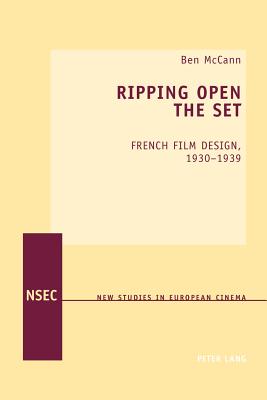
Book Details
Format
Paperback / softback
Book Series
New Studies in European Cinema
ISBN-10
3039103113
ISBN-13
9783039103119
Edition
New
Publisher
Verlag Peter Lang
Imprint
Verlag Peter Lang
Country of Manufacture
CH
Country of Publication
GB
Publication Date
May 7th, 2013
Print length
254 Pages
Weight
394 grams
Dimensions
22.70 x 15.00 x 1.50 cms
KSh 10,400.00
Currently unavailable
0 in stock
Delivery Location
Delivery fee: Select location
Secure
Quality
Fast
French film design throughout the 1930s was a period of ‘ripping open’ film sets to make them not just descriptive, but also expressive. This book details the elaborate paraphrasing tendencies of French film design in the period, exploring the crucial role of the set designer in the film’s evolutionary process.
French film design throughout the 1930s was not just descriptive, but also expressive: sets were not merely part of the background, but were vital components of a film’s overall atmosphere, impact and critical afterlife. This was a period when sets were ‘ripped open’, as painted backdrops were replaced by three-dimensional constructions to ensure greater proximity to reality. Accomplished set designers such as Alexandre Trauner, Jacques Krauss and Eugène Lourié crafted a series of designs both realist and expressionistic that brought out the underlying themes of a film’s narrative and helped create an exportable vision of ‘Frenchness’ that influenced other European and American film design practices.
This book details the elaborate paraphrasing tendencies of French film design in the 1930s. The author explores the crucial role of the set designer in the film’s evolutionary process and charts how the rapid development of studio practices enabled designers to become progressively more ambitious. The book examines key films such as Quatorze juillet (1932), Un Carnet de bal (1937), La Grande illusion (1937) and Le Jour se lève (1939) to demonstrate how set design works at establishing time and place, generating audience familiarity and recognition and underpinning each film’s visual style.
This book details the elaborate paraphrasing tendencies of French film design in the 1930s. The author explores the crucial role of the set designer in the film’s evolutionary process and charts how the rapid development of studio practices enabled designers to become progressively more ambitious. The book examines key films such as Quatorze juillet (1932), Un Carnet de bal (1937), La Grande illusion (1937) and Le Jour se lève (1939) to demonstrate how set design works at establishing time and place, generating audience familiarity and recognition and underpinning each film’s visual style.
Get Ripping Open the Set by Ben McCann at the best price and quality guaranteed only at Werezi Africa's largest book ecommerce store. The book was published by Verlag Peter Lang and it has 254 pages.
Customers Who Bought This Also Bought

Marvel Studios'' The Infinity Saga - Black Panther: The Art of the Movie
KSh 6,650.00

Documentary’s Transmedia Metamorphosis
KSh 12,250.00

The Business of Film
KSh 30,950.00

Sound Design and Film Narrative
KSh 30,950.00

Sound Design and Film Narrative
KSh 7,900.00

The Business of Film
KSh 7,200.00

Collaborative Educational Filmmaking
KSh 10,100.00
On Location in Cuba
KSh 5,750.00
Goin'' Crazy with Sam Peckinpah and All Our Friends
KSh 4,350.00
Writing, Directing, and Producing Documentary Films and Digital Videos: Fifth Edition
KSh 5,750.00

Film Festivals and the Enrichment Economy
KSh 7,200.00

Finance for Film and Television
KSh 7,900.00