
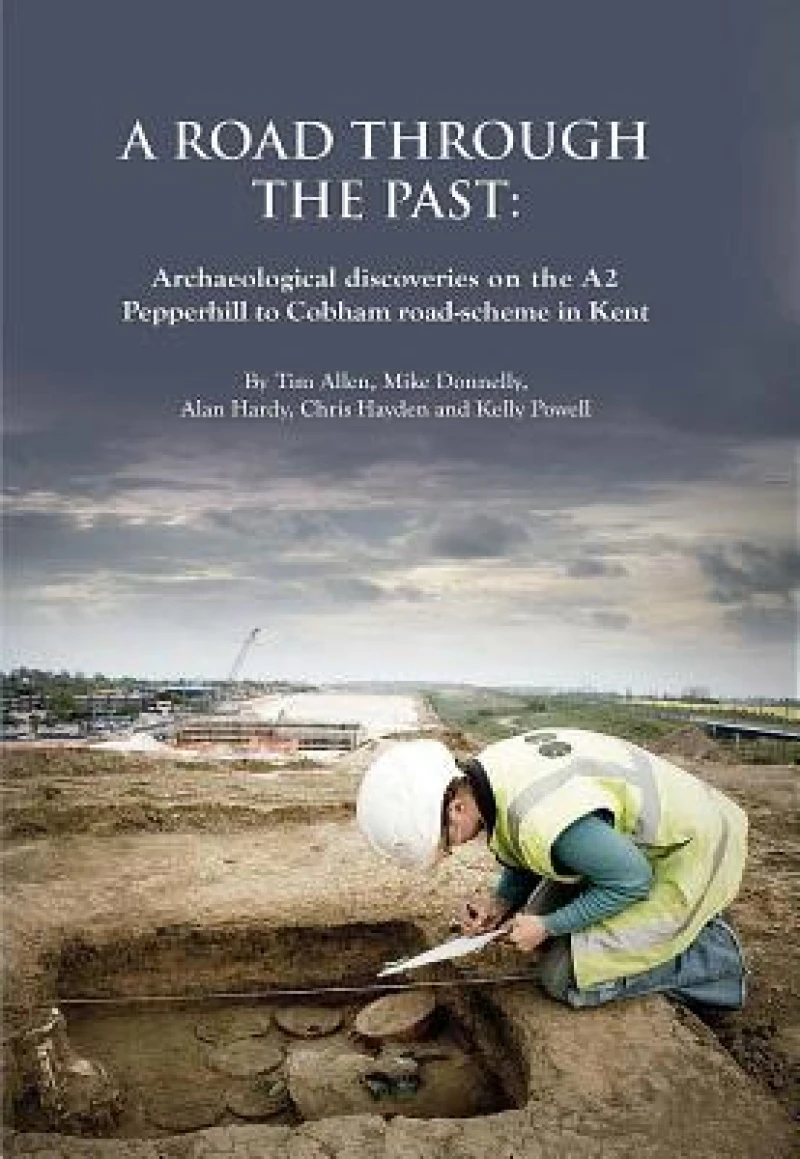
Road through the Past: Archaeological Discoveries on the A2 Pepperhill to Cobham Road-Scheme in Kent
Book Details
Format
Hardback or Cased Book
Book Series
Oxford Archaeology Monograph
ISBN-10
0904220680
ISBN-13
9780904220681
Publisher
Oxford Archaeology
Imprint
Oxford Archaeology
Country of Manufacture
GB
Country of Publication
GB
Publication Date
Jul 1st, 2012
Print length
644 Pages
Weight
2,610 grams
Dimensions
30.40 x 21.70 x 3.90 cms
Product Classification:
Archaeology by period / regionArchaeology by period / region
Ksh 9,150.00
Werezi Extended Catalogue
Delivery in 14 days
2 copies in stock
Delivery Location
Delivery fee: Select location
Delivery in 14 days
Secure
Quality
Fast
Oxford Archaeology carried out excavations for Skanska Construction (UK) Limited on behalf of the Highways Agency along a new road south of the then existing A2 between the Pepperhill and Marling Cross junctions. The road varied from 50m to 80m wide, and nearly 3km of the route (some 15ha) was stripped to archaeological levels prior to excavation. The route lay immediately north of the line of the previously excavated High Speed 1 (HS1). Additional areas (totalling 0.85ha) were excavated c 1km further east, where new ponds were being created north and south of the A2 alongside the Cobham services. Features of every period from Neolithic to post-medieval were found, together with residual Mesolithic flintwork. Early Neolithic activity included one very large posthole associated with a flint scatter east of Tollgate. Later Neolithic/early Bronze Age activity was slight, except for a Beaker pit containing a large assemblage of finds just west of Tollgate, not far from a double Beaker burial on the adjacent HS1.In the later middle Bronze Age two partial enclosures associated with probable metalled trackways were found, one containing a house, pits/hollows and fences, the other without internal features, but becoming a focus for later cremation burials. Scattered pits and cremations were also found further west. Late Bronze Age and earliest Iron Age activity was very sparse, but early Iron Age groups of pits were found at intervals along the route, often with fourpost structures and occasionally ditched boundaries. Some of the pits contained very rich assemblages of finds indicative of ritual deposition, and also included the largest collection of briquetage of this period from Kent. In the middle Iron Age activity became nucleated west of Tollgate, where another metalled trackway had enclosures, pits and four-post structures either side. This settlement continued in the late Iron Age, during which two high status burials took place, one in a bronze-bound bucket, the other accompanied by six brooches. Also in the middle Iron Age a major ditched boundary was dug overlooking the Downs Road dry valley, and burials were made within it and at its end. A ditched settlement was established at Cobham in the late Iron Age, but did not continue into the Roman period. In the early Roman period the focus of occupation shifted to a new, larger rectilinear enclosure overlooking the Tollgate dry valley. Only the northern edge was examined, but this contained one very large rich burial pit and an attached cemetery with two more high status burials, all dated AD 50–70. Other burials continued until the later 3rd century AD, when settlement activity also ceased. Fields were laid out alongside the major Iron Age boundary, and middle and late Roman burials continued in and alongside it, one of whom isotope analysis has shown to be a foreigner.Only a single isolated sunken-featured building could be dated to the Saxon period, but three low status medieval settlements of the 11th/12th centuries were found, two west of Tollgate and the third east of Cobham services. All three were characterised by sunken-featured buildings. Only one settlement continued and grew, but was abandoned in the mid 14th century.
Get Road through the Past: Archaeological Discoveries on the A2 Pepperhill to Cobham Road-Scheme in Kent by at the best price and quality guaranteed only at Werezi Africa's largest book ecommerce store. The book was published by Oxford Archaeology and it has pages.

