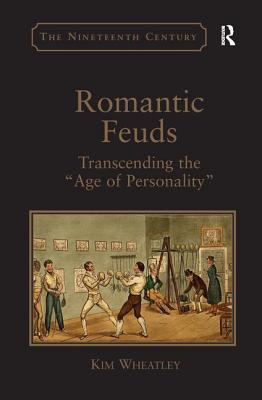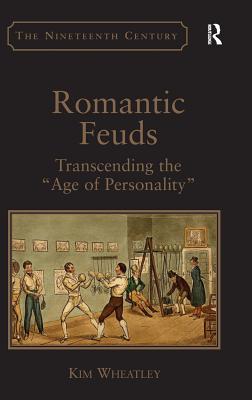
Romantic Feuds : Transcending the 'Age of Personality'
by
Kim Wheatley
Book Details
Format
Hardback
Book Series
The Nineteenth Century Series
ISBN-10
1409432726
ISBN-13
9781409432722
Publisher
Taylor & Francis Ltd
Imprint
Routledge
Country of Manufacture
GB
Country of Publication
GB
Publication Date
May 23rd, 2013
Print length
204 Pages
Weight
453 grams
Product Classification:
Literary studies: c 1800 to c 1900
KSh 18,700.00
Currently unavailable
0 in stock
Delivery Location
Delivery fee: Select location
Secure
Quality
Fast
Despite their desire to rise above the so-called "age of personality" and personal attacks, Romantic-era figures such as Robert Southey, Samuel Taylor Coleridge, Leigh Hunt, William Hazlitt, Sydney Owenson, and the explorer John Ross became enmeshed in public feuds with the Edinburgh Review and the Quarterly Review.
Romantic writers such as Robert Southey and Samuel Taylor Coleridge aspired to rise above the so-called ''age of personality,'' a new culture of politicized print gossip and personal attacks. Nevertheless, Southey, Coleridge, and other Romantic-era figures such as Leigh Hunt, William Hazlitt, Sydney Owenson, and the explorer John Ross became enmeshed in lively feuds with the major periodicals of the day, the Edinburgh Review and the Quarterly Review. Kim Wheatley focuses on feuds from the second and third decades of the nineteenth century, suggesting that by this time the vituperative rhetoric of the Edinburgh and the Quarterly had developed into what Coleridge called ''a habit of malignity.'' Attending to the formal strategies of the reviewers'' surprisingly creative prose, she traces how her chosen feuds take on lives of their own, branching off into other print media, including the weekly press and monthly magazines. Ultimately, Wheatley shows, these hostile exchanges incorporated literary genres and Romantic themes such as the idealized poetic self, the power of the supernatural, and the quest for the sublime. By turning episodes of print warfare into stories of transfiguration, the feuds thus unexpectedly contributed to the emergence of Romanticism.
Get Romantic Feuds by Kim Wheatley at the best price and quality guaranteed only at Werezi Africa's largest book ecommerce store. The book was published by Taylor & Francis Ltd and it has 204 pages.
Customers Who Bought This Also Bought
The Picture of Dorian Gray
KSh 1,250.00
Pride and Prejudice
KSh 1,150.00
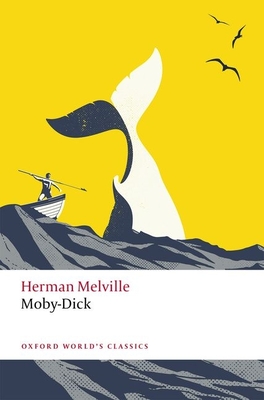
Moby-Dick
KSh 1,750.00
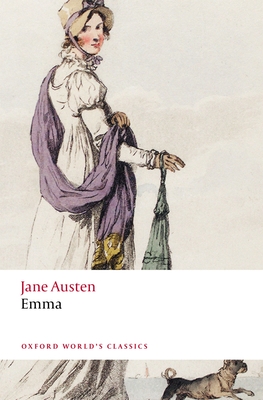
Emma
KSh 1,350.00
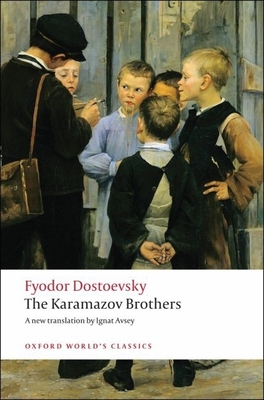
The Karamazov Brothers
KSh 2,100.00
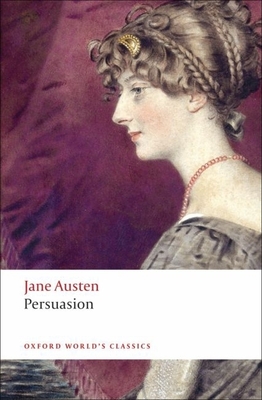
Persuasion
KSh 1,100.00

Bleak House
KSh 2,150.00
What Matters in Jane Austen?
KSh 2,700.00
A Tale of Two Cities
KSh 1,200.00
Little Women
KSh 1,550.00
David Copperfield
KSh 2,100.00
Mansfield Park
KSh 1,250.00