
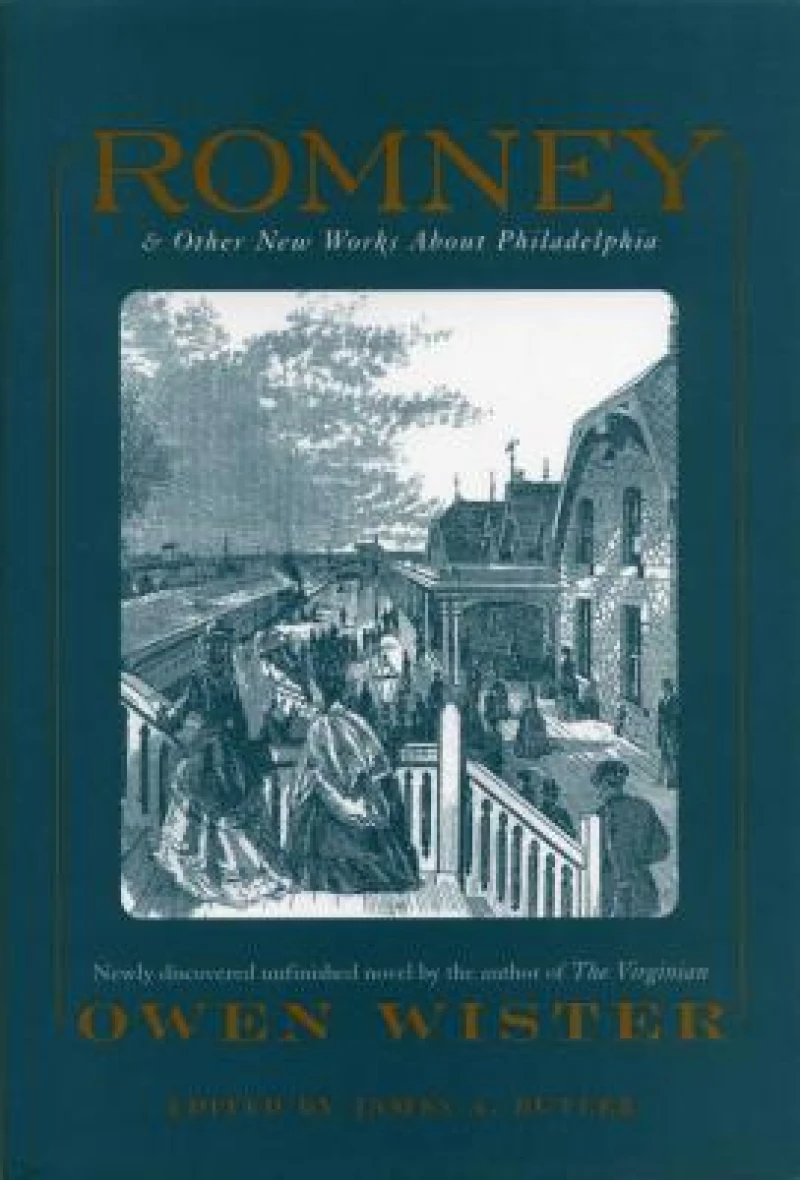
Romney – And Other New Works About Philadelphia By Owen Wister : And Other New Works About Philadelphia By Owen Wister
Book Details
Format
Hardback or Cased Book
ISBN-10
0271021217
ISBN-13
9780271021218
Publisher
Pennsylvania State University Press
Imprint
Pennsylvania State University Press
Country of Manufacture
US
Country of Publication
GB
Publication Date
Sep 1st, 2001
Print length
320 Pages
Weight
440 grams
Dimensions
13.90 x 20.10 x 2.90 cms
Ksh 7,900.00
Werezi Extended Catalogue
Delivery in 14 days
1 copies in stock
Delivery Location
Delivery fee: Select location
Delivery in 14 days
Secure
Quality
Fast
Romney is the best fictional portrayal of "Gilded Age" Philadelphia, brilliantly capturing Wister's vision of old-money, aristocratic society gasping its last before the onrushing vulgarity of the nouveaux riches. Published for the first time, is the complete fragment of Romney together with two of his other unpublished Philadelphia works.
Owen Wister is known to most Americans as the creator of the heroic cowboy in The Virginian (1902). Despite his success as a Western novelist, Wister's failure to write about his native city of Philadelphia has been lamented by many for the loss of a literary "might-have-been." If only, sighed Wister's contemporary Elizabeth Robins Pennell in 1914, the novelist could understand that Philadelphia was as good a subject as the Wild West. Hence the surprise when James Butler uncovered a substantial fragment of a Philadelphia novel, which Wister intended to call Romney. Here, published for the first time, is the complete fragment of Romney together with two of his other unpublished Philadelphia works. Even in its incomplete state—nearly fifty thousand words—Romney is Wister's longest piece of fiction after The Virginian and Lady Baltimore. Writing at the express command of his friend Theodore Roosevelt, Wister set Romney in Philadelphia (called Monopolis in the novel) during the 1880s, when, as he saw it, the city was passing from the old to a new order. The hero of the story, Romney, is a man of "no social position" who nonetheless rises to the top because he has superior ability. It is thus a novel about the possibilities for meaningful social change in a democracy. Although, alas, the story breaks off before the birth of Romney, Wister gives us much to savor in the existing thirteen chapters. We are treated to delightful scenes at the Bryn Mawr train station, the Bellevue Hotel, and Independence Square, which yield brilliant insights into life on the Main Line, the power of the Pennsylvania Railroad, and the insidious effects of political corruption. Wister's acute analysis in Romney of what differentiates Philadelphia and Boston upper classes is remarkably similar to, but anticipates by more than half a century, the classic study by E. Digby Baltzell in Puritan Boston and Quaker Philadelphia (1979). Like Baltzell, Wister analyzes the urban aristocracy of Boston and Philadelphia, finding in Boston a Puritan drive for achievement and civic service but in Philadelphia a Quaker preference for toleration and moderation, all too often leading to acquiescence and stagnation. Romney is undoubtedly the best fictional portrayal of "Gilded Age" Philadelphia, brilliantly capturing Wister's vision of old-money, aristocratic society gasping its last before the onrushing vulgarity of the nouveaux riches. It is a novel of manners that does for Philadelphia what Edith Wharton and John Marquand have done for New York and Boston.
Get Romney – And Other New Works About Philadelphia By Owen Wister by at the best price and quality guaranteed only at Werezi Africa's largest book ecommerce store. The book was published by Pennsylvania State University Press and it has pages.

