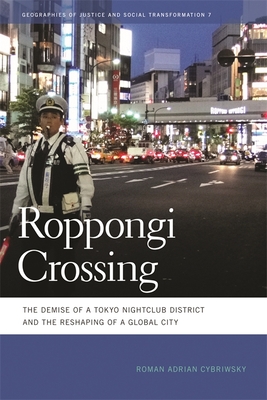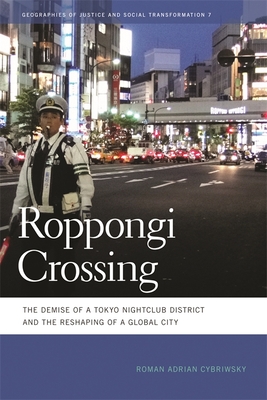
Roppongi Crossing : The Demise of a Tokyo Nightclub District and the Reshaping of a Global City
Book Details
Format
Paperback / softback
Book Series
Geographies of Justice and Social Transformation
ISBN-10
082033832X
ISBN-13
9780820338323
Publisher
University of Georgia Press
Imprint
University of Georgia Press
Country of Manufacture
US
Country of Publication
GB
Publication Date
Mar 15th, 2011
Print length
328 Pages
Weight
476 grams
Dimensions
22.90 x 15.20 x 1.90 cms
Product Classification:
Urban & municipal planningUrban and municipal planning and policy
KSh 6,100.00
Currently unavailable
0 in stock
Delivery Location
Delivery fee: Select location
Secure
Quality
Fast
Cybriwsky examines how Tokyo's Roppongi district's nightclub economy is now under siege by both heavy-handed police action and the conservative Japanese “construction state,” an alliance of large private builders and political interests with broad discretion to redevelop Tokyo.
For most of the latter half of the twentieth century, Roppongi was an enormously popular nightclub district that stood out from the other pleasure quarters of Tokyo for its mix of international entertainment and people. It was where Japanese and foreigners went to meet and play. With the crash of Japan’s bubble economy in the 1990s, however, the neighborhood declined, and it now has a reputation as perhaps Tokyo’s most dangerous district—a hotbed of illegal narcotics, prostitution, and other crimes. Its concentration of “bad foreigners,” many from China, Russia and Eastern Europe, West Africa, and Southeast Asia is thought to be the source of the trouble. Roman Adrian Cybriwsky examines how Roppongi’s nighttime economy is now under siege by both heavy-handed police action and the conservative Japanese “construction state,” an alliance of large private builders and political interests with broad discretion to redevelop Tokyo. The construction state sees an opportunity to turn prime real estate into high-end residential and retail projects that will “clean up” the area and make Tokyo more competitive with Shanghai and other rising business centers in Asia. Roppongi Crossing is a revealing ethnography of what is arguably the most dynamic district in one of the world’s most dynamic cities. Based on extensive fieldwork, it looks at the interplay between the neighborhood’s nighttime rhythms; its emerging daytime economy of office towers and shopping malls; Japan’s ongoing internationalization and changing ethnic mix; and Roppongi Hills and Tokyo Midtown, the massive new construction projects now looming over the old playground.
Get Roppongi Crossing by Roman Adrian Cybriwsky at the best price and quality guaranteed only at Werezi Africa's largest book ecommerce store. The book was published by University of Georgia Press and it has 328 pages.
Customers Who Bought This Also Bought

Death and Life of Great American Cities
KSh 3,600.00
Frankenstein Urbanism
KSh 7,900.00

Contemporary Latin American Architecture
KSh 7,900.00

Contemporary Latin American Architecture
KSh 30,950.00
Company Towns in the Americas
KSh 5,400.00

Robert Royston
KSh 5,550.00

World Cities Report 2026
KSh 13,050.00

Night Rules
KSh 30,950.00

Climate Bridge – An International Perspective on How to Enact Climate Action at the Government Public Interface
KSh 17,300.00
George Washington's Washington
KSh 6,300.00

The Politics of Urban Water
KSh 14,050.00

Fighting Sprawl and City Hall
KSh 3,600.00