
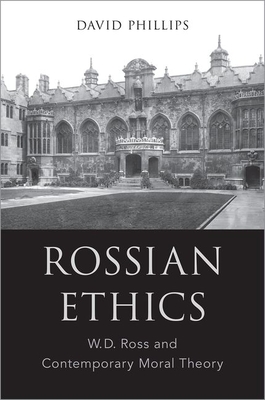
Rossian Ethics : W.D. Ross and Contemporary Moral Theory
Book Details
Format
Hardback
ISBN-10
019060218X
ISBN-13
9780190602185
Publisher
Oxford University Press Inc
Imprint
Oxford University Press Inc
Country of Manufacture
US
Country of Publication
GB
Publication Date
Aug 12th, 2019
Print length
232 Pages
Weight
363 grams
Dimensions
21.30 x 14.70 x 2.50 cms
Product Classification:
PhilosophyEthics & moral philosophySocial & political philosophyHistory of ideas
KSh 13,850.00
Temporarily out of stock, due soon
0 in stock
Delivery Location
Delivery fee: Select location
Secure
Quality
Fast
W.D. Ross (1877-1971) was the most important opponent of utilitarianism and consequentialism in British moral philosophy between 1861 and 1939. In Rossian Ethics, David Phillips offers the first monograph devoted exclusively to Ross''s seminal contribution to moral philosophy. The book has two connected aims. The first is to interpret and evaluate Ross''s moral theory. The second is to articulate a distinctive view intermediate between consequentialism and absolutist deontology, which Phillips calls "classical deontology."
W.D. Ross (1877-1971) was the most important opponent of utilitarianism and consequentialism in British moral philosophy between 1861 and 1939. In Rossian Ethics, David Phillips offers the first monograph devoted exclusively to Ross''s seminal contribution to moral philosophy.The book has two connected aims. The first is to interpret and evaluate Ross''s moral theory, focusing on its three key elements: his introduction of the concept of prima facie duty, his limited pluralism about the right, and his limited pluralism about the good. The metaethical and epistemological framework within which Ross develops his moral theory is the subject of the fifth and final chapter of the book. The second aim is to articulate a distinctive view intermediate between consequentialism and absolutist deontology, which Phillips calls "classical deontology." According to classical deontology the most fundamental normative principles are principles of prima facie duty, principles which specify general kinds of reasons. Consequentialists are right to think that reasons always derive from goods; ideal utilitarians are right, contra hedonistic utilitarians, to think that there are a small number of distinct kinds of intrinsic goods. But consequentialists are wrong to think that all reasons have the same weight for all agents. Instead there are a small number of distinct kinds of agent-relative intensifiers: features that increase the importance of certain goods for certain agents. Phillips claims that classical deontology combines the best elements of the moral theories of Ross and of Sidgwick, ultimately arguing that Ross is best interpreted as a classical deontologist.
Get Rossian Ethics by David Phillips at the best price and quality guaranteed only at Werezi Africa's largest book ecommerce store. The book was published by Oxford University Press Inc and it has 232 pages.
Customers Who Bought This Also Bought

Decolonizing Language and Other Revolutionary Ideas
KSh 2,350.00

How to Read a Book
KSh 2,000.00

Decolonizing Language and Other Revolutionary Ideas
KSh 3,600.00

Creative Act
KSh 3,250.00
Groundwork for the Metaphysics of Morals
KSh 2,000.00

Things in Nature Merely
KSh 2,000.00
Meditations – The Philosophy Classic
KSh 2,150.00

Great Ideas Social Contract
KSh 1,450.00
How to Be a Leader – An Ancient Guide to Wise Leadership
KSh 2,800.00

The Daily Laws
KSh 2,350.00

Three Critiques, 3-volume Set
KSh 14,000.00

Philosophical Dictionary
KSh 2,700.00
More by David Phillips

Vol 21: Railways & Recollections 1962
KSh 900.00

Railways and Recollections
KSh 1,100.00

Get into Medical School - 1320 UCAT Practice Questions
KSh 4,450.00

Railways and Recollections
KSh 1,100.00

Life And Scientific Legacy Of George Porter, The
KSh 36,900.00

Diversification in Modern Language Teaching
KSh 37,800.00

Railways and Recollections
KSh 1,100.00

Comparative Inquiry and Educational Policy Making
KSh 10,600.00

Augmenting Public Relations
KSh 8,900.00

Sidgwick''s The Methods of Ethics
KSh 18,500.00

Quality of Life
KSh 12,000.00

Life And Scientific Legacy Of George Porter, The
KSh 7,850.00
