
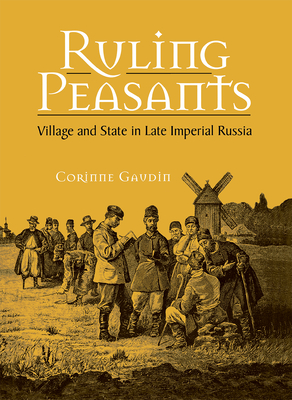
Ruling Peasants : Village and State in Late Imperial Russia
Book Details
Delivery Location
Delivery fee: Select location
Who ruled the countryside in late Imperial Russia? On the rare occasions that tsarist administrators dared pose the question so boldly, they reluctantly answered that the peasants ruled. Historians have largely echoed this assessment, pointing to the state''s failure to penetrate rural society as a key reason for the tsarist government''s collapse.
Ruling Peasants challenges this dominant paradigm of the closed village by investigating the ways peasants engaged tsarist laws and the local institutions that were created in a series of contradictory legal, administrative, and agrarian reforms from the late 1880s to the eve of World War I. Gaudin''s analysis of the practices of village assemblies, local courts, and elected peasant elders reveals a society riven by dissension. As villagers argued among themselves in terms defined by government, the peasants and their communities were transformed. Key concepts such as "custom," "commune," "property," and "fairness" were forged in such dialogue between the rulers and the ruled.
By the end of the nineteenth century, the framework of dialogue between the peasants and the state no longer worked. The more peasants used the institutions and laws available to them, the more they solicited the authorities, and the greater the obstacles to communication grew. Villagers'' rising expectations for assistance foundered in the face of inconsistent state policies and arbitrary legal responses. Ironically, the success of often contradictory reforms—a success unrecognized by administrators themselves—contributed to undermining the state''s legitimacy.
Get Ruling Peasants by Corinne Gaudin at the best price and quality guaranteed only at Werezi Africa's largest book ecommerce store. The book was published by Cornell University Press and it has 281 pages.
Customers Who Bought This Also Bought

Age of Revolutions
KSh 2,350.00
Eichmann in Jerusalem
KSh 2,350.00

Trouble With Being Born
KSh 2,000.00

Hiroshima
KSh 2,000.00

Freedom
KSh 6,300.00

Holocaust
KSh 2,700.00
The History of the Peloponnesian War
KSh 2,700.00
Annals
KSh 2,350.00
Greek Lives
KSh 2,150.00

Sleepwalkers
KSh 3,400.00

Napoleon The Great
KSh 3,600.00
Diary of a Young Girl
KSh 1,800.00
