
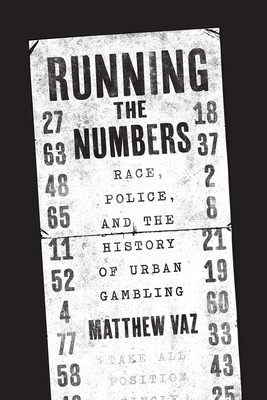
Running the Numbers : Race, Police, and the History of Urban Gambling
by
Matthew Vaz
Book Details
Format
Hardback
Book Series
Historical Studies of Urban America
ISBN-10
022669044X
ISBN-13
9780226690445
Publisher
The University of Chicago Press
Imprint
University of Chicago Press
Country of Manufacture
US
Country of Publication
GB
Publication Date
Apr 13th, 2020
Print length
208 Pages
Weight
412 grams
Dimensions
15.90 x 23.60 x 2.20 cms
KSh 5,600.00
Currently unavailable
0 in stock
Delivery Location
Delivery fee: Select location
Secure
Quality
Fast
Every day in the United States, people test their luck in numerous lotteries, from state-run games to massive programs like Powerball and Mega Millions. Yet few are aware that the origins of today’s lotteries can be found in an African American gambling economy that flourished in urban communities in the mid-twentieth century. In Running the Numbers, Matthew Vaz reveals how the politics of gambling became enmeshed in disputes over racial justice and police legitimacy. As Vaz highlights, early urban gamblers favored low-stakes games built around combinations of winning numbers. When these games became one of the largest economic engines in nonwhite areas like Harlem and Chicago’s south side, police took notice of the illegal business—and took advantage of new opportunities to benefit from graft and other corrupt practices. Eventually, governments found an unusual solution to the problems of illicit gambling and abusive police tactics: coopting the market through legal state-run lotteries, which could offer larger jackpots than any underground game. By tracing this process and the tensions and conflicts that propelled it, Vaz brilliantly calls attention to the fact that, much like education and housing in twentieth-century America, the gambling economy has also been a form of disputed terrain upon which racial power has been expressed, resisted, and reworked.
Get Running the Numbers by Matthew Vaz at the best price and quality guaranteed only at Werezi Africa's largest book ecommerce store. The book was published by The University of Chicago Press and it has 208 pages.
Customers Who Bought This Also Bought

Pimp: The Story Of My Life
KSh 2,000.00

All the President''s Men
KSh 2,000.00

Siege
KSh 2,000.00

Yahoo Boys
KSh 3,050.00

Just Mercy (Film Tie-In Edition)
KSh 2,000.00

Sleepers
KSh 2,150.00

This House of Grief
KSh 1,800.00

Yahoo Boys
KSh 3,950.00

We Wish to Inform You That Tomorrow We Will Be Killed With Our Families
KSh 2,150.00

In God's Name
KSh 2,350.00

The Art Thief
KSh 2,000.00
Story of a Murder
KSh 2,000.00

