
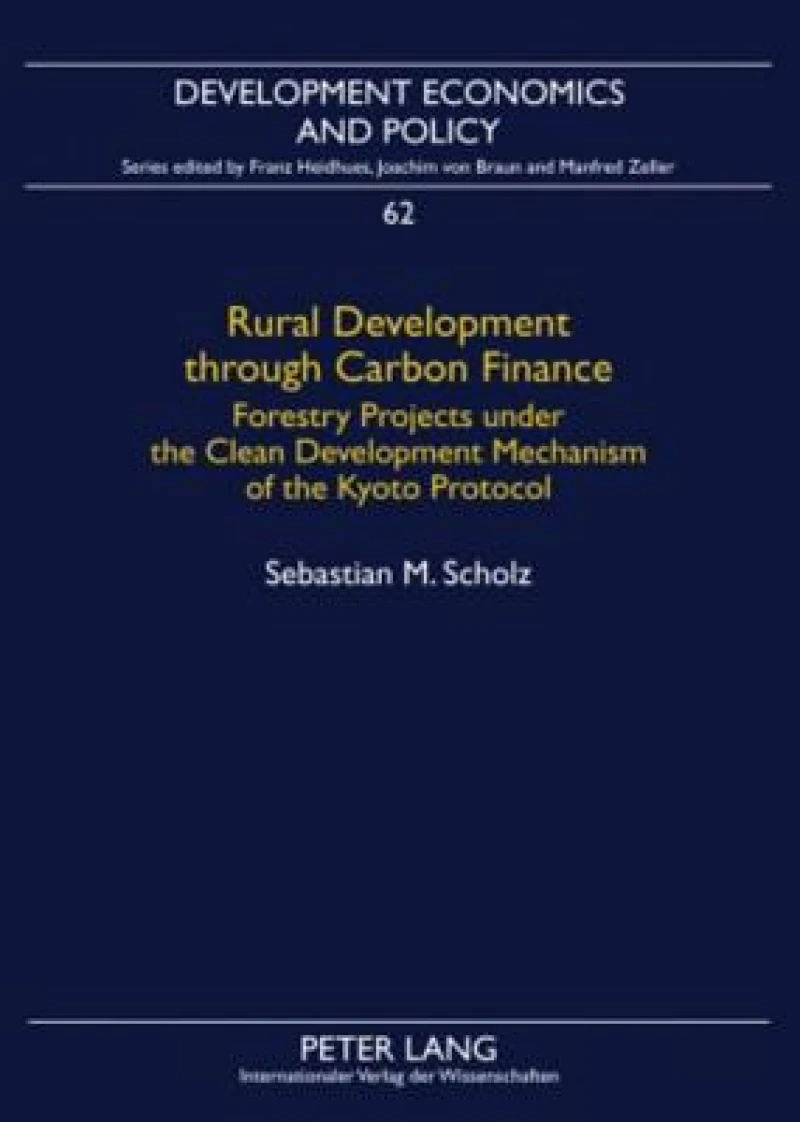
Rural Development through Carbon Finance : Forestry Projects under the Clean Development Mechanism of the Kyoto Protocol- Assessing Smallholder Participation by Structural Equation Modeling
New
Book Details
Format
Paperback / Softback
Book Series
Development Economics & Policy
ISBN-10
3631592507
ISBN-13
9783631592502
Edition
New
Publisher
Peter Lang AG
Imprint
Peter Lang AG
Country of Manufacture
DE
Country of Publication
GB
Publication Date
Apr 17th, 2009
Print length
198 Pages
Weight
296 grams
Dimensions
15.00 x 22.80 x 1.50 cms
Ksh 9,250.00
Manufactured on Demand
0 in stock
Delivery Location
Delivery fee: Select location
Secure
Quality
Fast
In a timely contribution to the international discussion of the post-Kyoto climate regime this study hypothesizes that Clean Development Mechanism (CDM) projects in the land use and forestry sector are an efficient instrument for climate change mitigation that contributes to rural development and poverty alleviation at the same time. To this end, the study analyzes socio-economic aspects of a forestry project established under the CDM rules considering an East African case study exemplarily. An agricultural household survey in Tanzania delivered the empirical data for the structural equation model at the center of the analysis. Looking at different farm assets it is shown that the benefits of land use-related climate projects go way beyond pure mitigation. They also have a positive impact on a very broad asset base on which poor farm households depend. Hence, the current CDM only allowing for afforestation and reforestation projects is far too restricted to deliver on its twin objective.
Get Rural Development through Carbon Finance by at the best price and quality guaranteed only at Werezi Africa's largest book ecommerce store. The book was published by Peter Lang AG and it has pages.

