
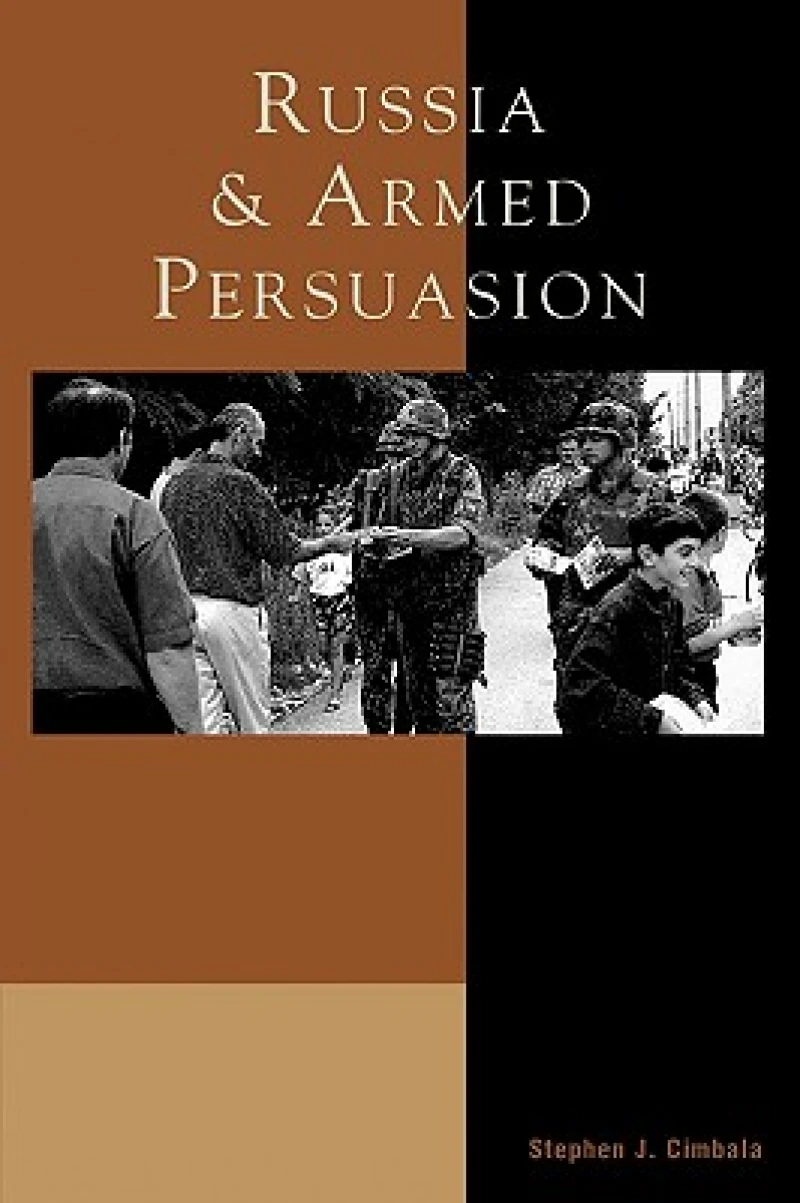
Russia and Armed Persuasion
Book Details
Format
Paperback / Softback
ISBN-10
0742509621
ISBN-13
9780742509627
Publisher
Bloomsbury Publishing Plc
Imprint
Rowman & Littlefield Publishers
Country of Manufacture
GB
Country of Publication
GB
Publication Date
Nov 1st, 2001
Print length
256 Pages
Weight
336 grams
Dimensions
22.40 x 15.50 x 1.60 cms
Product Classification:
Political science & theoryInternational relationsMilitary tactics
Ksh 9,000.00
Manufactured on Demand
0 in stock
Delivery Location
Delivery fee: Select location
Secure
Quality
Fast
In Russia and Armed Persuasion, Stephen J. Cimbala argues that Russia's war planners and political leaders must make painful adjustments in their thinking about the relationship between military art and policy.
In Russia and Armed Persuasion, Stephen J. Cimbala argues that Russia''s war planners and political leaders must make painful adjustments in their thinking about the relationship between military art and policy in the twenty-first century. Russia must master the use of force for persuasion, not just destruction. As the author shows, military persuasion requires that Russian leaders master the politico-military complexity of crisis management, deterrence and arms control, and the limitation of ends and means in war. Russia now has scarce resources to devote to defense and can no longer afford the stick-only diplomacy and strategy that have characterized some of its recent past. Russian and Soviet military thinking historically emphasized the blunderbuss and total war: overwhelming mass, firepower, and conflicts of annihilation or prolonged attrition. However, historical experience also forced Russia and the Soviet Union to come to grips with crisis management and with limited aims and means in the conduct of war. On the one hand, Russia failed the test of military persuasion in its management of the July 1914 crisis that plunged Europe into World War I. On the other hand, the Soviet Union did adjust to the requirements of the nuclear age for crisis management, deterrence, and limited war. Using this mixed record of Russian and Soviet success and failure in twentieth century experience, Cimbala argues that Russia can, and must, improve in the twenty-first century. According to the author, the first decades of this century will pose at least three immediate challenges to Russia''s military persuasion. Russia must continue to pursue strategic nuclear arms control and arms reductions, with the United States and avoid re-starting the Cold War by means of an ill-considered race in missile defenses. Second, Russia must maintain a surer grip on the military information revolution, especially as it pertains to the management of Russia''s nuclear deterrent. Third, Russia must develop forces that are more flexible in small wars and peace operations: its recent experiences in Chechnya show that it has a long way to go in using economy of force as a military persuader. Cimbala''s original analysis demonstrates the similar features in apparently dissimilar, or even opposite, events and processes. For example, he shows how the problem of military persuasion applies equally to the challenge of managing a nuclear crisis and the problem of low-intensity war. In each case, the dilemma is calibrating the military means to the political ends. Controversially, the author argues against both military and academic traditionalists, contending that the complexity of the force-policy relationship in the next century will reward the subtle users of military power and that others will be subject to a ''Gulliver effect'' of diminishing returns.
Get Russia and Armed Persuasion by at the best price and quality guaranteed only at Werezi Africa's largest book ecommerce store. The book was published by Bloomsbury Publishing Plc and it has pages.

