
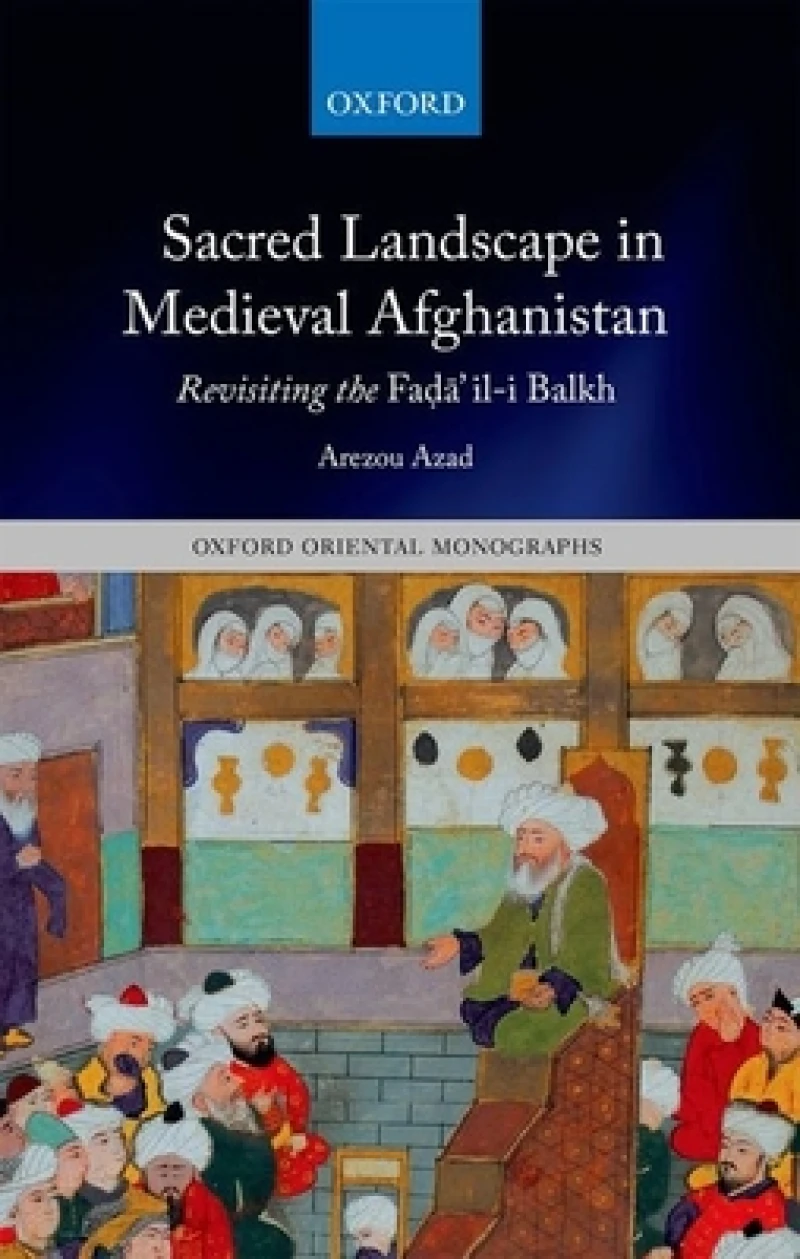
Sacred Landscape in Medieval Afghanistan : Revisiting the Fada"il-i Balkh
by
Arezou Azad
Book Details
Format
Hardback or Cased Book
Book Series
Oxford Oriental Monographs
ISBN-10
0199687056
ISBN-13
9780199687053
Publisher
Oxford University Press
Imprint
Oxford University Press
Country of Manufacture
GB
Country of Publication
GB
Publication Date
Dec 12th, 2013
Print length
240 Pages
Weight
458 grams
Dimensions
22.30 x 14.60 x 2.00 cms
Product Classification:
History of religionBuddhist worship, rites & ceremoniesIslamic life & practice
Ksh 26,000.00
Manufactured on Demand
0 in stock
Delivery Location
Delivery fee: Select location
Secure
Quality
Fast
Afghanistan has played a crucial role in shaping the history of Islam. This book provides the first in-depth study of the sacred sites and landscape of medieval Balkh, in today's northern Afghanistan, in the five centuries from the Islamic conquests of the eighth century to the arrival of the Mongols in the thirteenth century.
This book is about a sacred place called Balkh, known to the ancient Greeks as Bactra. Located in the north of today''s Afghanistan, along the silk road, Balkh was holy to many. The Prophet Zoroaster is rumoured to have died here, and during late antiquity, Balkh was the home of the Naw Bahār, a famed Buddhist temple and monastery. By the tenth century, Balkh had become a critical centre of Islamic learning and early poetry in the New Persian language that grew after the Islamic conquests and continues to be spoken in Iran, Afghanistan and parts of Central Asia today.In this book, Arezou Azad provides the first in-depth study of the sacred sites and landscape of medieval Balkh, which continues to exemplify age-old sanctity in the Persian-speaking world and the eastern lands of Islam generally. Azad focuses on the five centuries from the Islamic conquests in the eighth century to just before the arrival of the Mongols in the thirteenth century, the crucial period in the emergence of Perso-Islamic historiography and Islamic legal thought. The book traces the development of ''sacred landscape'', the notion that a place has a sensory meaning, as distinct from a purely topographical space. This opens up new possibilities for our understanding of Islamisation in the eastern Islamic lands, and specifically the transition from Buddhism to Islam. Azad offers a new look at the medieval local history of Balkh, the Faḍā"il-i Balkh, and analyses its creation of a sacred landscape for Balkh. In doing so, she provides a compelling example of how the sacredness of a place is perpetuated through narratives, irrespective of the dominant religion or religious strand of the time.
Get Sacred Landscape in Medieval Afghanistan by at the best price and quality guaranteed only at Werezi Africa's largest book ecommerce store. The book was published by Oxford University Press and it has pages.

