
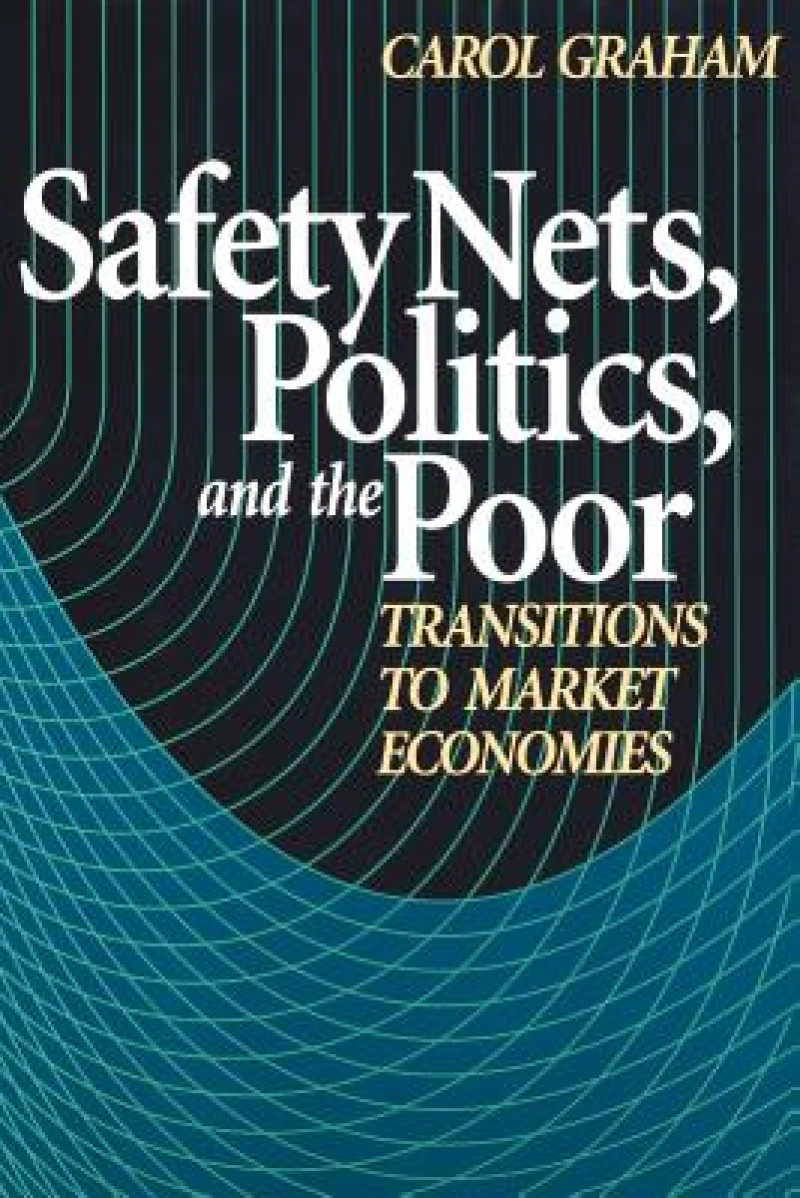
Safety Nets, Politics, and the Poor : Transitions to Market Economies
Book Details
Format
Paperback / Softback
ISBN-10
0815734034
ISBN-13
9780815734031
Publisher
Rowman & Littlefield
Imprint
Brookings Institution
Country of Manufacture
GB
Country of Publication
GB
Publication Date
Oct 30th, 2017
Print length
392 Pages
Weight
45 grams
Product Classification:
Development studiesDevelopment economics & emerging economies
Ksh 6,300.00
Re-Printing
0 in stock
Delivery Location
Delivery fee: Select location
Secure
Quality
Fast
Countries worldwide are attempting difficult transitions from state-planned to market economies. Most of these countries have fragile democratic regimes that are threatened by the high social and political costs of reform. Governments?and ultimately societies?have to make hard choices about allocating scarce public resources as they undergo these transitions. A central, often controversial, and most poignant question is how to protect vulnerable groups and the poor. What compensation, what ""safety net"" will be provided for them?Carol Graham argues that safety nets can provide an environment in which economic reform is more politically sustainable and poverty can be permanently reduced. However, these two objectives frequently involve trade-offs, as vocal and organized opponents of reform (for obvious political reasons) often concern governments far more than the poor. These organized and less vulnerable groups tend to place heavy demands on the scarce resources available to governments at times of economic crisis. Governments that fail to address the social costs of reform, meanwhile, often face popular opposition that jeopardizes or even derails the entire market transition-the results of the September 1993 elections in Poland are a case in point. The author examines these trade-offs in detail, with a particular focus on how political and institutional contexts affect the kinds of safety nets that are implemented. For example, reaching the poor and vulnerable with safety nets tends to be more difficult in closed-party systems, such as in Senegal, where entrenched interest groups have a monopoly on state benefits. In contrast, dramatic political change or rapid implementation of economic reform undermines the influence of such groups and therefore can provide unique political opportunities to redirect resources to the poor, as in the case of Bolivia and Zambia. Rather than focus their efforts on organized interest groups-such as public sector unions-which have a great deal to lose in the process of reform, governments might better concentrate their efforts on poor groups that have rarely, if ever, received benefits from the state. The poor, meanwhile, may gain a new stake in the ongoing process of economic and public sector reform through organizing to solicit the state for safety net benefits. This is the first book to provide a detailed and comparative analysis of compensation during economic reform. Graham offers specific examples of resource allocation in three regions: Latin America, Africa, and Eastern Europe. She features case studies from Chile, Bolivia, Peru, Senegal, Zambia, and Poland.
Get Safety Nets, Politics, and the Poor by at the best price and quality guaranteed only at Werezi Africa's largest book ecommerce store. The book was published by Rowman & Littlefield and it has pages.

