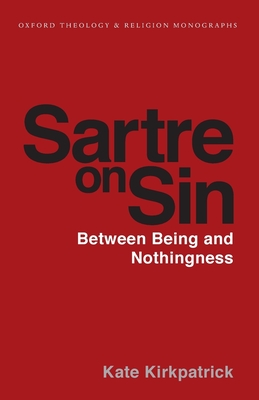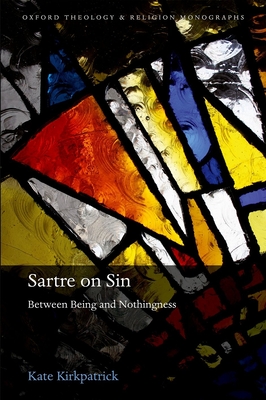
Sartre on Sin : Between Being and Nothingness
Book Details
Format
Hardback
Book Series
Oxford Theology and Religion Monographs
ISBN-10
019881173X
ISBN-13
9780198811732
Publisher
Oxford University Press
Imprint
Oxford University Press
Country of Manufacture
GB
Country of Publication
GB
Publication Date
Nov 2nd, 2017
Print length
278 Pages
Weight
482 grams
Dimensions
22.40 x 14.90 x 2.40 cms
KSh 21,200.00
Currently unavailable
0 in stock
Delivery Location
Delivery fee: Select location
Secure
Quality
Fast
This work argues that Jean-Paul Sartre's early philosophy had a notable inheritance from the Christian doctrine of original sin. With particular attention to Being and Nothingness, Kirkpatrick connects Sartre to an Augustinian tradition of Christian thought according to which nothingness enters the world with the creation of the human.
Sartre on Sin: Between Being and Nothingness argues that Jean-Paul Sartre''s early, anti-humanist philosophy is indebted to the Christian doctrine of original sin. On the standard reading, Sartre''s most fundamental and attractive idea is freedom: he wished to demonstrate the existence of human freedom, and did so by connecting consciousness with nothingness. Focusing on Being and Nothingness, Kate Kirkpatrick demonstrates that Sartre''s concept of nothingness (le néant) has a Christian genealogy which has been overlooked in philosophical and theological discussions of his work. Previous scholars have noted the resemblance between Sartre''s and Augustine''s ontologies: to name but one shared theme, both thinkers describe the human as the being through which nothingness enters the world. However, there has been no previous in-depth examination of this ''resemblance''. Using historical, exegetical, and conceptual methods, Kirkpatrick demonstrates that Sartre''s intellectual formation prior to his discovery of phenomenology included theological elements-especially concerning the compatibility of freedom with sin and grace. After outlining the French Augustinianisms by which Sartre''s account of the human as ''between being and nothingness'' was informed, Kirkpatrick offers a close reading of Being and Nothingness which shows that the psychological, epistemological, and ethical consequences of Sartre''s le néant closely resemble the consequences of its theological predecessor; and that his account of freedom can be read as an anti-theodicy. Sartre on Sin illustrates that Sartre'' s insights are valuable resources for contemporary hamartiology.
Get Sartre on Sin by Kate Kirkpatrick at the best price and quality guaranteed only at Werezi Africa's largest book ecommerce store. The book was published by Oxford University Press and it has 278 pages.
Customers Who Bought This Also Bought

History of Sexuality: 2
KSh 2,350.00

Capitalism
KSh 2,700.00

History of Sexuality: 1
KSh 2,350.00
Intelligence and Spirit
KSh 5,750.00

Dark Matter
KSh 12,600.00
The Critical Mythology of Irony
KSh 5,450.00
Relativism in the Arts
KSh 5,000.00
Jurisdiction in Deleuze: The Expression and Representation of Law
KSh 30,950.00

The Negative Turn in Comparative Law
KSh 8,950.00
Transcendental History
KSh 8,100.00

Borges Between Singularity and Sovereignty
KSh 5,150.00
On Deconstruction
KSh 4,850.00