
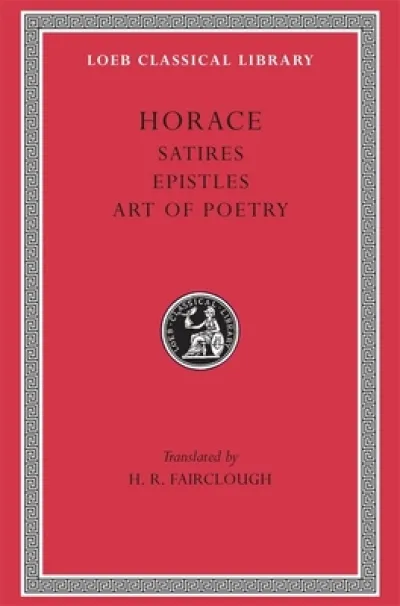
Satires. Epistles. The Art of Poetry Fairclough)(Latin)
by
Horace
Book Details
Format
Hardback or Cased Book
Book Series
Loeb Classical Library
ISBN-10
0674992148
ISBN-13
9780674992146
Publisher
Harvard University Press
Imprint
LOEB
Country of Manufacture
US
Country of Publication
GB
Publication Date
Jan 1st, 1926
Print length
544 Pages
Weight
390 grams
Dimensions
17.30 x 11.80 x 2.90 cms
Product Classification:
Literary essaysEssays
Ksh 4,500.00
Temporarily out of stock, due soon
0 in stock
Delivery Location
Delivery fee: Select location
Secure
Quality
Fast
The poetry of Horace is richly varied, its focus moving between public and private concerns, urban and rural settings, Stoic and Epicurean thought. In the Satires Horace mocks himself as well as the world. His verse epistles include the Art of Poetry, in which he famously expounds his literary theory.
Artful hexameters. Horace (Quintus Horatius Flaccus, 65–8 BC) was born at Venusia, son of a freedman clerk who had him well educated at Rome and Athens. Horace supported the ill-fated killers of Caesar, lost his property, became a secretary in the Treasury, and began to write poetry. Maecenas, lover of literature, to whom Virgil and Varius introduced Horace in 39, became his friend and made him largely independent by giving him a farm. After 30 Horace knew and aided with his pen the emperor Augustus, who after Virgil’s death in 19 engaged him to celebrate imperial affairs in poetry. Horace refused to become Augustus’ private secretary and died a few months after Maecenas. Both lyric (in various metres) and other work (in hexameters) was spread over the period 40–10 or 9 BC. It is Roman in spirit, Greek in technique. In the two books of Satires Horace is a moderate social critic and commentator; the two books of Epistles are more intimate and polished, the second book being literary criticism as is also the Ars Poetica. The Epodes in various (mostly iambic) metres are akin to the ‘discourses’ (as Horace called his satires and epistles) but also look towards the famous Odes, in four books, in the old Greek lyric metres used with much skill. Some are national odes about public affairs; some are pleasant poems of love and wine; some are moral letters; all have a rare perfection. The Odes and Epodes are found in LCL 33.
Get Satires. Epistles. The Art of Poetry Fairclough)(Latin) by at the best price and quality guaranteed only at Werezi Africa's largest book ecommerce store. The book was published by Harvard University Press and it has pages.

